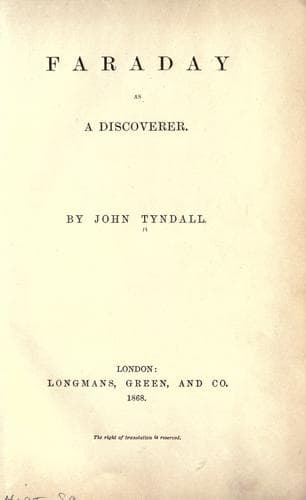
Faraday, Michael, 1791-1867; Physicists -- Great Britain -- Biography
In the year 1851, I had the honour of an interview with Humboldt, in
Berlin, and his parting words to me then were, 'Tell Faraday that I
entirely agree with him, and that he has, in my opinion, completely
explained the variation of the declination.' Eminent men have since
informed me that Humboldt was hasty in expressing this opinion. In
fact, Faraday's memoirs on atmospheric magnetism lost much of their
force--perhaps too much--through the important discovery of the relation
of the variation of the declination to the number of the solar spots.
But I agree with him and M. Edmond Becquerel, who worked independently
at this subject, in thinking, that a body so magnetic as oxygen,
swathing the earth, and subject to variations of temperature, diurnal
and annual, must affect the manifestations of terrestrial magnetism.[1]
The air that stands upon a single square foot of the earth's surface
is, according to Faraday, equivalent in magnetic force to 8160 lbs.
of crystallized protosulphate of iron. Such a substance cannot be
absolutely neutral as regards the deportment of the magnetic needle. But
Faraday's writings on this subject are so voluminous, and the theoretic
points are so novel and intricate, that I shall postpone the complete
analysis of these researches to a time when I can lay hold of them more
completely than my other duties allow me to do now.
Footnote to Chapter 12
[1] This persuasion has been greatly strengthened by the
recent perusal of a paper by Mr. Baxendell.
Chapter 13.
Speculations: nature of matter: lines of force
The scientific picture of Faraday would not be complete without a
reference to his speculative writings. On Friday, January 19, 1844,
he opened the weekly evening-meetings of the Royal Institution by a
discourse entitled 'A speculation touching Electric Conduction and the
nature of Matter.' In this discourse he not only attempts the overthrow
of Dalton's Theory of Atoms, but also the subversion of all ordinary
scientific ideas regarding the nature and relations of Matter and Force.
He objected to the use of the term atom:--'I have not yet found a
mind,' he says, 'that did habitually separate it from its accompanying
temptations; and there can be no doubt that the words definite
proportions, equivalent, primes, &c., which did and do fully express all
the facts of what is usually called the atomic theory in chemistry, were
dismissed because they were not expressive enough, and did not say all
that was in the mind of him who used the word atom in their stead.'
Public-domain text, read in full here on John Shaqi.
Reviews
Reviews
No reviews yet
Be the first to share your thoughts on this work.
Elsewhere in the archive
Join the Discussion
Join the discussion
Sign in to leave a comment or review.
Sign InorCreate an account