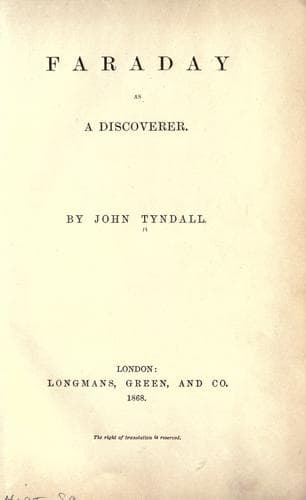
Faraday, Michael, 1791-1867; Physicists -- Great Britain -- Biography
A moment will be granted me to indicate my own view of Faraday's
position here. The word 'atom' was not used in the stead of definite
proportions, equivalents, or primes. These terms represented facts that
followed from, but were not equivalent to, the atomic theory. Facts
cannot satisfy the mind: and the law of definite combining proportions
being once established, the question 'why should combination take place
according to that law?' is inevitable. Dalton answered this question by
the enunciation of the Atomic Theory, the fundamental idea of which
is, in my opinion, perfectly secure. The objection of Faraday to Dalton
might be urged with the same substantial force against Newton: it might
be stated with regard to the planetary motions that the laws of
Kepler revealed the facts; that the introduction of the principle of
gravitation was an addition to the facts. But this is the essence of
all theory. The theory is the backward guess from fact to principle;
the conjecture, or divination regarding something, which lies behind
the facts, and from which they flow in necessary sequence. If Dalton's
theory, then, account for the definite proportions observed in the
combinations of chemistry, its justification rests upon the same basis
as that of the principle of gravitation. All that can in strictness be
said in either case is that the facts occur as if the principle existed.
The manner in which Faraday himself habitually deals with his hypotheses
is revealed in this lecture. He incessantly employed them to gain
experimental ends, but he incessantly took them down, as an architect
removes the scaffolding when the edifice is complete. 'I cannot but
doubt,' he says, 'that he who as a mere philosopher has most power of
penetrating the secrets of nature, and guessing by hypothesis at her
mode of working, will also be most careful for his own safe progress
and that of others, to distinguish the knowledge which consists of
assumption, by which I mean theory and hypothesis, from that which is
the knowledge of facts and laws.' Faraday himself, in fact, was
always 'guessing by hypothesis,' and making theoretic divination the
stepping-stone to his experimental results.
I have already more than once dwelt on the vividness with which he
realised molecular conditions; we have a fine example of this strength
and brightness of imagination in the present 'speculation.' He grapples
with the notion that matter is made up of particles, not in absolute
contact, but surrounded by interatomic space. 'Space,' he observes,
'must be taken as the only continuous part of a body so constituted.
Space will permeate all masses of matter in every direction like a net,
except that in place of meshes it will form cells, isolating each atom
from its neighbours, itself only being continuous.'
Public-domain text, read in full here on John Shaqi.
Reviews
Reviews
No reviews yet
Be the first to share your thoughts on this work.
Elsewhere in the archive
Join the Discussion
Join the discussion
Sign in to leave a comment or review.
Sign InorCreate an account