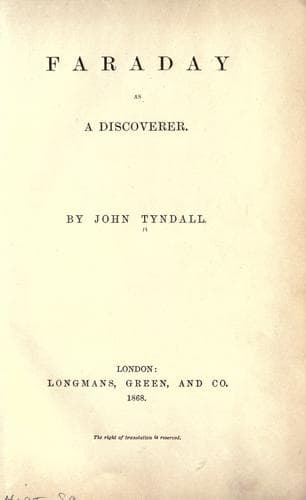
Faraday, Michael, 1791-1867; Physicists -- Great Britain -- Biography
It was my wish and aspiration to play the part of Schiller to this
Goethe: and he was at times so strong and joyful--his body so active,
and his intellect so clear--as to suggest to me the thought that
he, like Goethe, would see the younger man laid low. Destiny ruled
otherwise, and now he is but a memory to us all. Surely no memory could
be more beautiful. He was equally rich in mind and heart. The
fairest traits of a character sketched by Paul, found in him perfect
illustration. For he was 'blameless, vigilant, sober, of good behaviour,
apt to teach, not given to filthy lucre.' He had not a trace of worldly
ambition; he declared his duty to his Sovereign by going to the levee
once a year, but beyond this he never sought contact with the great.
The life of his spirit and of his intellect was so full, that the things
which men most strive after were absolutely indifferent to him. 'Give me
health and a day,' says the brave Emerson, 'and I will make the pomp of
emperors ridiculous.' In an eminent degree Faraday could say the same.
What to him was the splendour of a palace compared with a thunderstorm
upon Brighton Downs?--what among all the appliances of royalty to
compare with the setting sun? I refer to a thunderstorm and a sunset,
because these things excited a kind of ecstasy in his mind, and to
a mind open to such ecstasy the pomps and pleasures of the world are
usually of small account. Nature, not education, rendered Faraday strong
and refined. A favourite experiment of his own was representative of
himself. He loved to show that water in crystallizing excluded all
foreign ingredients, however intimately they might be mixed with it. Out
of acids, alkalis, or saline solutions, the crystal came sweet and pure.
By some such natural process in the formation of this man, beauty and
nobleness coalesced, to the exclusion of everything vulgar and low. He
did not learn his gentleness in the world, for he withdrew himself from
its culture; and still this land of England contained no truer gentleman
than he. Not half his greatness was incorporate in his science, for
science could not reveal the bravery and delicacy of his heart.
But it is time that I should end these weak words, and lay my poor
garland on the grave of this
Just and faithful knight of God.
End of the Project Gutenberg EBook of Faraday As A Discoverer, by John Tyndall
Public-domain text, read in full here on John Shaqi.
Reviews
Reviews
No reviews yet
Be the first to share your thoughts on this work.
Elsewhere in the archive
Join the Discussion
Join the discussion
Sign in to leave a comment or review.
Sign InorCreate an account