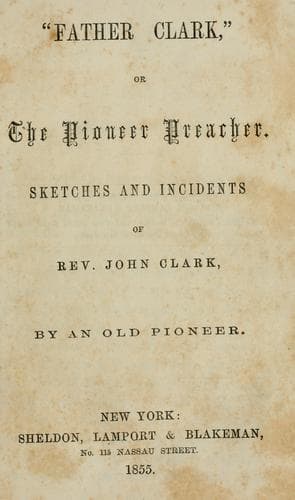
"Father Clark," or The Pioneer PreacherPeck, John Mason
History
"Father Clark," or The Pioneer Preacher
Peck, John Mason
Clark, John, 1758-1833; Methodist Episcopal Church -- Clergy
There was so much simplicity and honest effort in the
boy that the master made a kind effort to relieve his pupil. “Why,
boy, cannot ye mind th’em? They ar’ _Mister Shaderack, Mes-hack, and
Abed-ye-go_. Now ye mought go on with y’r lesson; and don’t ye miss ’em
agin.”
Spelling, reading, writing and the mere elements of simple arithmetic
were all that these and many others pretended to teach. The
difficulties encountered in obtaining a small amount of education by
children in Illinois, from the earliest American settlements to the
close of the last century were greater, and books more difficult to be
procured than when Mr. Clark taught in Kentucky. The price of a single
copy of “Dilworth’s New Guide to the English Tongue,” as the title page
read, was one dollar. And none but old copies of the coarsest paper,
the refuse of old stores and printing offices, sold at auction, were
brought to this remote frontier. No classes were organized, nor could
there be any uniformity of books. The masters ruled, not with “a rod
of iron,” but a wand of hickory, four feet long. The teachers were
turned out at Christmas, when the king of misrule took the chair, and
lawlessness prevailed. Not only were the scenes enacted, we described
in chapter ninth, in Kentucky, but even more lamentable and ludicrous
ones.
A few years later, one of the whiskey-loving sons of Erin attempted to
teach in a settlement known to the writer, who received the tale from
one of the employers. Our informant, who loved his dram, despised all
meanness and selfishness, and he regarded a man who would “suck a jug”
in secret, as about the meanest of the race. Hence he “abominated” the
schoolmaster, and gloried in the tricks some of the youngsters played
him. The master was observed by the shrewd young men under his charge,
to retire from the cabin to a thicket during the hours for lessons, and
in proportion to these occasions of retirement, his eyes grew dull, his
tongue wagged heavily, and his natural jabbering as an Irish pedagogue,
became more unintelligible.
A search warrant in a verbal form was issued and served on the thicket
by two smart young men; the whiskey bottle was found, and in quite
a private way received a full allowance of tartar-emetic, and then
carefully deposited in its accustomed hiding place. Next day the master
was seized suddenly with an alarming illness. It would have been
called cholera, but that disease was unknown on these frontiers at that
period. But, as our informant expressed it, “he was orfully skeered,
and glad enough to have us let him off from his article.”
Public-domain text, read in full here on John Shaqi.
Reviews
Reviews
No reviews yet
Be the first to share your thoughts on this work.
Elsewhere in the archive
Join the Discussion
Join the discussion
Sign in to leave a comment or review.
Sign InorCreate an account