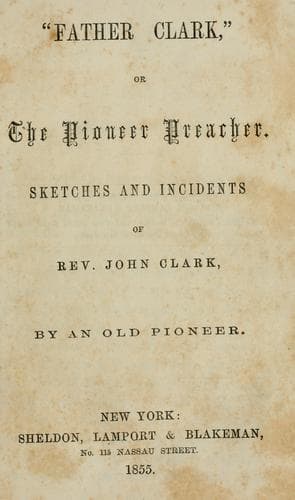
"Father Clark," or The Pioneer PreacherPeck, John Mason
History
"Father Clark," or The Pioneer Preacher
Peck, John Mason
Clark, John, 1758-1833; Methodist Episcopal Church -- Clergy
Under each head he touched on the peculiarities of each sect, and
showed that each held a portion of divine truth, and did valiant
service in the army of Prince Emanuel.
There was just enough of quaintness and eccentricity in this mode of
preaching the gospel to keep every one wide awake, and cause every
hearer to remember and “inwardly digest” what he heard. Few men would
crowd into a sermon more evangelical thoughts, or make more vivid and
happy illustrations.
The old pioneer was not less interested in the impressive sermon of
Mr. Going on missions, and the wonderful progress made in the work of
translating and publishing the Scriptures, and preaching the gospel to
the heathen.
At the close of such exhilarating meetings, a lively hymn is sung, and
the friendly grasp of the hand of christian fellowship extended through
the highly excited congregation.
Brethren crowded towards the stand to reach the hand of the “strange
brother,” who had so opportunely appeared in the “Far-West.” Some one
called on him to come down from the platform, where all the people
could approach him.
Father Clark, whose day of discharge every one knew could not be far
distant, approached with light in his eyes and joy in his countenance.
He first seized one hand with a nervous grasp, then the other;
then struck both palms on his shoulders, and before there was time
to reflect, threw both arms around his body with an affectionate
embrace, and gave him the ancient salutation on both cheeks. The vast
congregation were melted, and many voices became so tremulous that the
singing almost ceased.
But “the end of all things is at hand.” The friends of Father Clark saw
the infirmities of age pressing on him. His walks were limited, his
preaching less frequent, and his visits to families were fewer and at
longer intervals.
He had gained a home in every family he visited, and a place in
every Christian heart. There was no murmuring; nor fretfulness; no
complaining of the degeneracy of the age, which is the common failing
of old men.
His friends gave him money whenever he needed it. He was seldom known
to have a larger sum than fifty cents at one time, and then he felt
uneasy until he found some deserving object of charity to relieve him.
He desired nothing, sought nothing, and needed nothing of this world’s
wealth. His wants were few and promptly supplied by his friends. He had
every comfort he desired. He lived among a people where hospitality
is a cardinal virtue, and the kind feelings of his friends were
exhaustless.
Knowing his increasing infirmities, the author made an effort to visit
him at William Patterson’s house on Coldwater, but found he had gone
to another home on Fox Creek, and pressing engagements prevented going
there. The pen was substituted for a personal interview, and a sketch
of his eventful life was commenced, but failing strength prevented its
completion.[62]
Public-domain text, read in full here on John Shaqi.
Reviews
Reviews
No reviews yet
Be the first to share your thoughts on this work.
Elsewhere in the archive
Join the Discussion
Join the discussion
Sign in to leave a comment or review.
Sign InorCreate an account