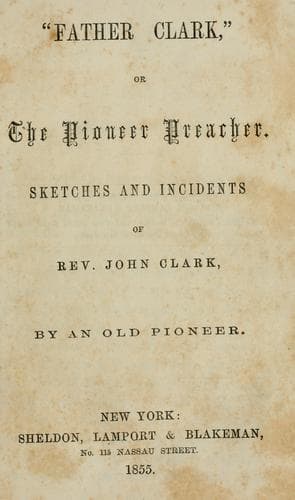
"Father Clark," or The Pioneer PreacherPeck, John Mason
History
"Father Clark," or The Pioneer Preacher
Peck, John Mason
Clark, John, 1758-1833; Methodist Episcopal Church -- Clergy
“I saw him on his death-bed. He insisted on being taken to the meeting
place. It was done. He enjoyed himself under preaching. Class meeting
followed. The old man seemed like a person returned to his home and his
friends like a long absence, exulting, rejoicing, and declaring that
for many years he had been subject to doubts about his acceptance with
God; but that for fours years past, he had not a doubt, and was calmly
waiting for his departure. The next time I came to the place, I laid
him in the tomb. He had returned to the same house to be at meeting,
but on the preceding day was called to the great assembly above.”
FUNERAL DISCOURSES.
It has been customary throughout the south and west to preach funeral
discourses, after interment, at such time as may accommodate the
largest number of friends or relatives. Rev. Messrs. James and Joseph
Lemen had been selected by Mr. Clark for this purpose. After conferring
with those more directly concerned, the following places were selected,
and due notice given in the papers.
Bethel meeting-house in St. Clair county, the first Sabbath in
February;--New Design, in Monroe county, second Sabbath;--Judge Brown,
in Greene county, on the third Sabbath;--and Coldwater in Missouri, at
William Patterson’s, the fourth Sabbath in February. It was stated in
the notice,--“The object in preaching at these several places, is to
afford opportunity to the friends of our deceased Father to join in
paying this last tribute of respect to his worthy memory. These places
furnish central localities in the great moral vineyard, where his
labors were ordinarily bestowed.” Immense congregations attended these
appointments.
FOOTNOTES
[1] The true aboriginal name of the MISSISSIPPI.
[2] Prov. xxiii: 5.
[3] Transport ships are engaged in carrying soldiers and munitions of
war from one country to another.
[4] 1 Cor. xv: 33.
[5] Eccl. vii: 14.
[6] A convoy is one or more ships of war sent to protect merchant
vessels and transports.
[7] Technically “burst.”
[8] A Letter of Marque is a merchant vessel, licensed to go armed, and
fight in defense in time of war.
[9] A cartel is an agreement between nations at war, for exchange of
prisoners. It is also used for the vessel that brings them home.
[10] They proved to be the captain and two mates of the vessel.
[11] Jer. x: 23.
[12] Job xxviii: 28.--Ps. cxi: 10.--Prov. i: 7; ix: 10; xv: 33.--Luke
xii: 5.
[13] Job xvi: 2.
[14] Ezek. xviii: 20.
[15] Luke xviii: 13.
[16] Acts ix: 6.
[17] Psalmist, H. 472.
[18] Rom. viii: 14-17.
[19] 1 Cor. xii: 3.
[20] 2 Peter iii: 18.
[21] Looking into the History of the Methodist Episcopal Church, by
Rev. Dr. Bangs, Vol. 1, p. 253, we find the following under 1786.
Public-domain text, read in full here on John Shaqi.
Reviews
Reviews
No reviews yet
Be the first to share your thoughts on this work.
Elsewhere in the archive
Join the Discussion
Join the discussion
Sign in to leave a comment or review.
Sign InorCreate an account