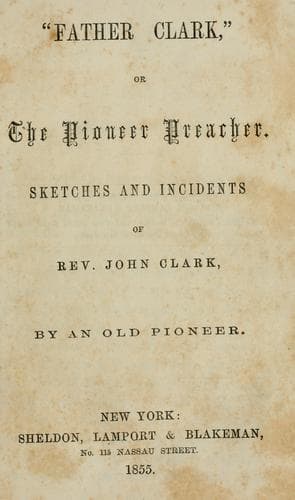
"Father Clark," or The Pioneer PreacherPeck, John Mason
History
"Father Clark," or The Pioneer Preacher
Peck, John Mason
Clark, John, 1758-1833; Methodist Episcopal Church -- Clergy
[34] At that period (1796,) the Methodists had five circuits in
Kentucky, ten preachers in the traveling connection, and 1880 whites
and 64 blacks in their societies. Their preachers, learning that
Mr. Clark had left the Methodist connection, gave him no direct
encouragement as a preacher. Mr. Jolliff, Rev. J. Lillard, and two or
three other preachers were Independent Methodists, and affiliated with
Clark.
According to Asplund’s Register, there were 57 Baptist churches, 50
ordained ministers, 16 licentiates, and 3,453 members, in 1792. Twenty
per cent. increase at least should be added for their number in 1796.
This would give 4,150 communicants.
[35] Pictures.
[36] It will not be thought strange that such a boy as Thomas Bush
(which is a fictitious name for a real personage) became a graduate
of Transylvania University, studied law in Lexington, was elected to
Congress, and became a Judge of the Court. In all these stations he
was an honor to himself, and to those who trained him for usefulness
and respectability. He also became a Christian professor, lived a
life of faith in Jesus Christ, and died in the full hope of a blessed
immortality.
[37] Whiskey in which cherries have been steeped.
[38] This is the aboriginal meaning of Mississippi.
[39] Their towns were situated about twenty miles a little east of
north from Springfield, and not far from where now the Chicago and
Mississippi railroad crosses Salt Creek, in Logan county. Kickapoo, a
branch of Salt Creek, may be seen on the sectional map of Illinois.
[40] The cordelle is a long rope attached to the bow of the boat, and
drawn over the shoulders of the men, who walk along the bank. The
setting-pole is about ten or twelve feet long, with the lower end shod
with iron, and the upper end terminating in a knob, which is pressed
against the shoulder, and the men who use them walk forwards on the
narrow gunwale, in a very stooping posture, with their faces towards
the stern. This shoves the boat against a strong current. When the
hands on the gunwale next the shore drop their poles and catch hold of
limbs and bushes that overhang the river and pull the boat forward, it
is called “bush-whacking.” Oars are used in crossing the river from
one shore to the other. A long heavy oar with a wide blade is attached
to the stern so as to move on a pivot, and the steersman, who is
commandant for the occasion, directs the boatmen. This was the mode of
ascending western rivers before the “Age of Steam.”
[41] A species of New England rum, brought from New Orleans.
[42] James Lemen, Sen., became a Baptist preacher, and died January
8th, 1823. He left four sons in the ministry, all of whom, venerable
men, are still living in 1854.
[43] Judge Martin’s History of Louisiana, vol. ii, p. 90.
[44] Ibid, p. 153.
Public-domain text, read in full here on John Shaqi.
Reviews
Reviews
No reviews yet
Be the first to share your thoughts on this work.
Elsewhere in the archive
Join the Discussion
Join the discussion
Sign in to leave a comment or review.
Sign InorCreate an account