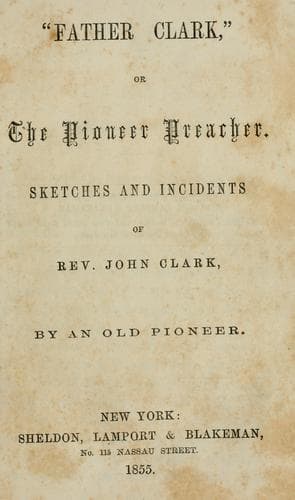
"Father Clark," or The Pioneer PreacherPeck, John Mason
History
"Father Clark," or The Pioneer Preacher
Peck, John Mason
Clark, John, 1758-1833; Methodist Episcopal Church -- Clergy
Time passed away;--the school increased, until the dirty old cabin was
more than crowded. During the warm season, those who _studied_ their
lessons (and this was one of the new fashions introduced), could retire
to the shade of the forest, and in groups of two, three and four, might
have been seen by passers by, intently conning their lessons. But cold
weather approached, the people became quite spirited in providing a new
and better house for winter; and the whole settlement turned out with
their axes and teams. Large trees were felled in the adjacent forest,
and rough hewn on two sides to a suitable thickness. Clap boards, four
feet long, were split from a straight grained oak for the roof; the
ends of the logs were securely notched together and were placed one
on top of another, as the four sides of the house were raised. In a
few days a commodious house, about twenty feet square, and covered in,
stood a few yards from the old log cabin. The spaces between the logs
were soon “chinked and daubed;” that is, filled with small flat stones
and chumps of wood, and mud plastered over the cracks both within and
without.
For windows, a log was cut out from each side at a suitable height for
the light to shine on the writing desks, which were slabs placed under
the windows. The apertures were a foot wide and extended the length
of the room, over which paper saturated with coon oil was placed as a
substitute for glass. The chimney was built in the end opposite the
door, and ran up outside of the wall. An aperture about ten feet wide
was made through the logs for the fire-place. The chimney was built of
rough stones from the neighboring quarry. And as quite an advancement
in the style of frontier school houses at that period, planks, as the
term was in Kentucky, or boards an inch and a quarter thick, cut at a
saw-mill on a branch of Crab Orchard Creek, made a tight floor. It is
doubtful if out of Lexington, and a half-dozen other towns, a school
house existed in the country settlements with any other floor than the
natural earth beaten hard, until this improvement was made both as an
accommodation and a compliment to their teacher.
Mr. Clark had two or three young men from eighteen to twenty years of
age, who had been under his tuition from the opening of the school,
and who desired to qualify themselves for teachers. They were good
tempered, affable, constant in their studies, and made good progress.
The school now promised to have a greater number and variety of pupils
than Mr. Clark could attend to and do justice to all. He proposed to
these young men to assist him in the smaller classes, and by that means
they would be qualified the sooner and the more thoroughly to teach and
govern a school.
Public-domain text, read in full here on John Shaqi.
Reviews
Reviews
No reviews yet
Be the first to share your thoughts on this work.
Elsewhere in the archive
Join the Discussion
Join the discussion
Sign in to leave a comment or review.
Sign InorCreate an account