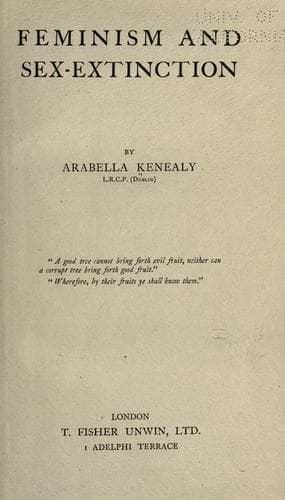
Feminism; Women; Women -- Social and moral questions; Women -- Social conditions
She overlooks the portentous truth that a law is the expression of a
general aspiration toward an ideal for which a people is striving. That
a law is broken proves that the higher in man moves him to set a
standard beyond his power--or beside his inclination--to sustain
undeviatingly. Yet although he may not act up to it undeviatingly, it
stands, nevertheless, for the ideal he realises that he should reach.
Abolition of a good and elevating law proves, therefore, not only the
serious lapse of a community from an established standard of conduct,
but it inevitably lowers the level of conduct by removing
barriers--self-respect and self-restraint, public opinion and so
forth--standing in the way of laxity. Despite the death-penalty, murders
are committed. But were the death-penalty to be abolished, murder would
increase by leaps and bounds. The human mind is strangely susceptible.
And the power of habits acquired under fear of penalties is an
invaluable force for good. The higher minds of a community evolve and
establish codes for lesser minds to shape by. And undoubtedly the
subconscious as well as the conscious shaping toward such standards
furthers development in the directions thereof. To make honesty a matter
of personal choice, with no penalties attaching to theft, would be in
itself an incentive to theft.
Comparison with polygamous countries, of countries in which monogamy is
the law, refutes straightway Miss Key's discredit of monogamy; showing
the polygamous uncivilised, unenlightened, unprogressive, subject to
monogamous races, and in every sense, both materially and morally
decadent. And if, with a notion of establishing equality in all things
between the sexes by emancipating woman from the higher moral code,
leasehold marriage or other forms of wedded laxity should be
substituted--not only would national purity, but personal character and
happiness too would suffer grievously.
If men have not kept the monogamous law, the instinct of jealousy,
reinforced by repugnance to supporting alien offspring, has seen to it
that wives should trespass as seldom, at all events, as was possible to
be guarded against. Custom and public opinion, furthered by personal
fear and fear of divorce, have all contributed toward advancing ideals
of womanly honour and conduct. And from monogamous mothers--whether
voluntarily or involuntarily so--progress has derived immense impulse.
Apart from biological considerations, the benefit to the family of the
mother's influence centred in her home and kept from straying thence,
either by her own aspirations, by public opinion, or by fear of the
husband, has been incalculable.
During and since the War, crime among children has increased by 50 per
cent., largely owing to absence of mothers from their homes, working or
drinking, or otherwise dissipating, while their children have been left
to run wild in the streets.
Public-domain text, read in full here on John Shaqi.
Reviews
Reviews
No reviews yet
Be the first to share your thoughts on this work.
Elsewhere in the archive
Join the Discussion
Join the discussion
Sign in to leave a comment or review.
Sign InorCreate an account