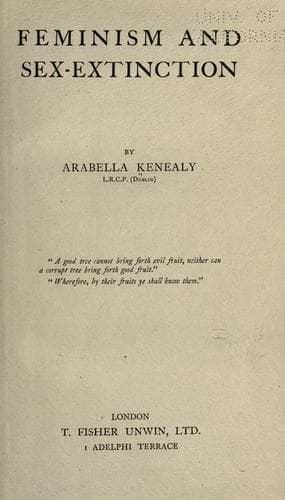
Feminism; Women; Women -- Social and moral questions; Women -- Social conditions
The finality of the bond, if it does not always prevent one or both from
meeting some other they prefer, prevents the scrupulous, at all events,
from seeking such. Or having found, it keeps many from fostering and
from yielding to temptation. Were marriage terminable, or, as is
sometimes proposed, were it abolished wholly, and love the only bond
between the sexes, there would be no confidence, no sense of security
between the partners, no stability of family life; no centring of
interests in this, and but small endeavour to retain affections which
for the many could be easily replaced--and replaced, moreover, with the
zest of novelty. On the contrary, a curse of unrest would afflict the
vast majority of married folk with the unsettling--mayhap with the
alluring--prospect of meeting their further "Fate"; perhaps their
second, possibly their third, it might be, their seventh "Fate."
Only the few are strong enough of heart or stable enough of character to
remain steadfast for a lifetime in any undertaking, unless bound
stringently thereto by authorised obligations, incentives, and
penalties. Only the few are deep enough of nature to love for a
lifetime; or are deep enough of nature to love so intensely as to
justify altering the marriage-code in order to spare these few
suffering. The wane of nine out of ten honeymoons impresses the value of
an inflexible decree that declines to reckon with disillusion, but
sternly bids the disillusioned take up their burden and make the best of
it. And having no choice, many do this and make a success of it--on new,
and, it may be, on far higher lines than those they had set out upon.
That but few love so deeply as to love for life by no means implies that
marriage for less than a lifetime should be substituted. It shows, on
the contrary, that the majority of persons would prove as incapable of
loving No. Two for long as they had been incapable of loving No. One; or
as they would be incapable of loving No. Three, or No. Ten. A bond that
rivets them for life to No. One therefore, and entails loss or suffering
when they fail to abide by it, is safeguard for them against such a
succession of loves as would be as demoralising to the individual as it
must be destructive of society.
Examples of this tendency to amorous licence have been furnished by the
complications of War-"widows," who, on report of the death of
soldier-husbands, remarried in unseemly haste--only to find the husband
return. So too, by the widespread infidelity of wives to absent
soldier-husbands. If the grave and moving circumstance of a husband
facing death or mutilation in the trenches, for his country's defence,
was not grave nor moving enough to keep his wife faithful to him, then
we should congratulate ourselves upon a marriage-law which, by exacting
penalties whereby such a wife suffers material damage, supplies the only
argument likely to stiffen the morale of so light-minded and callous a
creature.
Public-domain text, read in full here on John Shaqi.
Reviews
Reviews
No reviews yet
Be the first to share your thoughts on this work.
Elsewhere in the archive
Join the Discussion
Join the discussion
Sign in to leave a comment or review.
Sign InorCreate an account