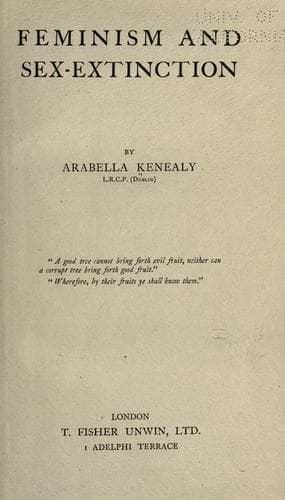
Feminism; Women; Women -- Social and moral questions; Women -- Social conditions
Legislators who are over-confident in the efficacy of The Law express
their over-confidence in terms of premature and unduly-coercive
legislation. Procedure which, more often than not, frustrates the ends
to which it was designed by the methods taken to secure these. Progress
is personal, moreover. It is the sum of the advance of individuals.
Legislation is the statutory _formulation_ of public opinion; it is not
the _source_ of this. It merely crystallises public opinion. But before
crystallisation of thought (as of chemical) sets in, saturation-point
must first have been reached throughout the medium wherein it occurs.
Were any other development required to show the utter inadequacy of
Legislation to attain its ends--when not reinforced by personal
co-operation and initiative--this has been supplied in that latter-day
demoralisation of young girls, the consequences whereof will be vastly
more baneful and farther-reaching in contributing to national decline
than even that other dire factor of the flower of our virile youth
struck down before its prime.
Girls are fully protected by law to the age of sixteen. Yet many of the
demoralised girls seen consorting freely with Tommy or Reggie, according
to their class, are well below that age. Legislation is powerless,
however, failing parental vigilance and co-operation to invoke its aid.
Nevertheless, with its characteristic blind confidence in the male
prerogative of Law, Feminism now advocates raising "the age of consent"
to eighteen. But to do this would no more protect the girl under
eighteen than the existing law protects the girl under sixteen--or, for
that matter, protects the girl of twelve. Law can do little or nothing
unless, as happens so seldom and happens too late, parents requisition
its assistance for menace or for punishment. Mothers themselves should
see to it that their little daughters have neither temptation nor
opportunity to consent to their own ruin.
IV
We saw lately a militant rising of women against men and their laws; the
object being to compel concessions from the male by way of violence. And
so short-sighted were the leaders of this Movement that not only did
they seek to prove their right to make laws, by breaking them, but they
showed themselves ignorant of the first rudiments of combat by electing
to fight the enemy with his own weapon--that weapon of Force which is
man's especial Fitness and Woman's Unfitness. Woman's Unfitnesses have
prevailed, it is true, in the counsels of progress, but, obviously, they
have not prevailed, nor can they ever prevail by being pitted directly
against masculine strengths. Her way of supremacy is one by far more
subtle and sublime.
Public-domain text, read in full here on John Shaqi.
Reviews
Reviews
No reviews yet
Be the first to share your thoughts on this work.
Elsewhere in the archive
Join the Discussion
Join the discussion
Sign in to leave a comment or review.
Sign InorCreate an account