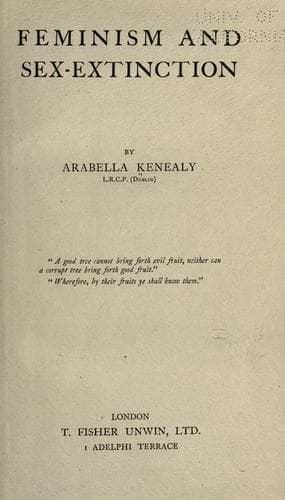
Feminism; Women; Women -- Social and moral questions; Women -- Social conditions
The crux of the demand for equal pay for equal work is that, because of
her natural lesser strength and endurance, when a woman is doing work
identical in nature and equal in quantum to that of a man, it means that
_she_ is doing _more_ than a woman's work, and is overtaxing and
injuring her constitution, therefore; or it means that _he_ is doing
_less_ than a man's work, and is "slacking," therefore.
A further important issue is that when rendered too easy by both husband
and wife earning wage, marriage is entered upon far too lightly, and at
too early and irresponsible ages, than happens when the whole burden of
support rests with the man. Moreover, in such case masculine selection
makes only too often for economic rather than for human values in the
wife. A man upon whom is to fall the whole tax of supporting the home
and the family regards marriage more seriously, and delays it until he
is more mature of years and of settled position. Moreover, he chooses
more carefully. And the Race benefits proportionally.
In manufacturing towns, with opportunity for both husband and wife
earning wage, boy-and-girl marriages, feckless, discordant homes, and
sickly degenerate, neglected children are the rule.
That women should be paid for work they do, a salary enabling them to
live honestly and in comfort, goes without saying. Economics should be
adjusted on a far higher basis than that mainly of a competitive
struggle which allows the employer to fix wages less according to the
value of work done, than by the number of persons at his mercy, who, in
their eagerness to live, will undersell their values and thus cheapen
labour. Nevertheless economics have, in a degree, adapted to the
evolutionary trend. Because, in the main, the more skilled and difficult
tasks are more highly remunerated than the less skilled, and are
performed by the more fit. And not only are these better qualified to
expend such higher remuneration intelligently, and with benefit to
themselves and to the community, but they are able to secure thereby
those better conditions which are the due and the need of families
higher in the scale of humanity, and requiring, therefore, higher
conditions of nurture.
The cases of colliers and of other rough-grade humans who earn wage
beyond their mental calibre to expend intelligently, show how an income
too large for its possessor leads to coarse and demoralising
extravagances, rather than to personal happiness or elevation. (The like
is true of many plutocrats.) War has shown us boys' lives wrecked by the
same factor. No greater fallacy exists than that of supposing progress
to lie in freeing persons from all disabilities--poverty, and other
restrictive conditions.
Wives should be legally entitled to a just proportion of their husband's
income, as a _right_, not merely as dole. This, in recognition of their
invaluable work in home-making, and of their invaluable service to the
State in producing and rearing worthy citizens for it.
VI
Public-domain text, read in full here on John Shaqi.
Reviews
Reviews
No reviews yet
Be the first to share your thoughts on this work.
Elsewhere in the archive
Join the Discussion
Join the discussion
Sign in to leave a comment or review.
Sign InorCreate an account