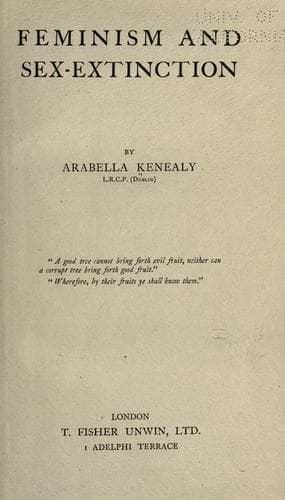
Feminism; Women; Women -- Social and moral questions; Women -- Social conditions
Such a prohibition, by lessening the competition of the labour-market,
and by thus increasing the value of labour (which the flood of female
industry inevitably cheapens) would automatically so increase the wage
of men as to make of these true living wage, sufficient for the
maintenance of home and family. Such a prohibition would, moreover, so
diminish the competitive pressure among women as to make it possible for
unmarried women, the future wives and mothers, as well as for the older
spinsters and widows, to select in every fitting trade and industry,
work suited to the lesser strength and endurance of the female brain and
body.
VII
Nothing has characterised the Feminist Movement throughout so much as
lack of knowledge of human nature (both masculine and feminine), lack
of prevision to foresee the trend of new developments, lack of intuitive
apprehension to gauge the issues of such trend. Its leaders have never
suspected, accordingly, that, in propaganda and in practice, they have
been tampering with a great biological ordinance; and that, in
obliterating women's Sex-characteristics, they have been destroying that
counterpoise of human powers and faculties whereon progress and
permanence rest, and that morale which is the inspiration of advance.
Regarding their own masculine Rationalism as the ideal and standard for
all women, they have believed it possible to shape all women
successfully thereto. Nature is not to be thwarted, however. And when we
destroy the balance of the Normal, abnormal developments--gravely
mischievous and singularly difficult to deal with--crop up and require
to be dealt with. One may raise the familiar cry that some modern
developments are due to our being in "a transition stage." But from that
remote day when Nature first evolved us as a race of _amoebæ_, further
to evolve into the human species, we have been always in "transition
stages." Normal transition upwards is so slow an impulse as to be
well-nigh imperceptible, however. Rapid change invariably betokens
regression--descent being vastly easier and swifter in movement than
ascent is.
Deplorably mistaken has been a doctrine of Emancipation which, by
disparaging the arts domestic, has sent out young girls and women,
indiscriminately, from the sphere domestic, to de-sexing and
demoralising work in factories and businesses; and has engendered the
race of stunted, precocious, bold-eyed, cigarette-smoking, free-living
working-girls who fill our streets; many tricked out like cocottes, eyes
roving after men, impudence upon their tongues, their poor brains
vitiated by vulgar rag-times and cinema-scenes of vice and
suggestiveness.
Some of our working-girls are charming-looking, pretty-mannered, pure
of thought and life, of course. A small minority--alas, how small!--are
normal of development and sound of constitution. But these are not the
average. And it is the average with which a nation has to reckon.
Public-domain text, read in full here on John Shaqi.
Reviews
Reviews
No reviews yet
Be the first to share your thoughts on this work.
Elsewhere in the archive
Join the Discussion
Join the discussion
Sign in to leave a comment or review.
Sign InorCreate an account