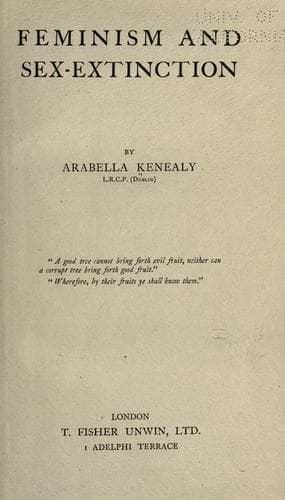
Feminism; Women; Women -- Social and moral questions; Women -- Social conditions
George Eliot, too, affected the masculine both in viewpoint and
method--a bad habit which so grew upon her that her later novels are
ponderous as political treatises, and devoid of human interest.
Far different, Charlotte Brontë. True to herself and to her sex, she
wrote and has written for all time--as those others did not--as a woman,
and as only a woman could have written. Jane Austen, likewise.
The woman point-of-view and method are regarded, for the most part,
however, as mark of the amateur--the model aimed at being the eternal
masculine in mode and trend.
If the demand, "_We take all labour for our province!_" be safeguarded
by recognising and differentiating the province into two distinct and
separate--supplementary and complementary--departments, for the
respective labours of the two widely differing sexes, the claim comes
first within the range of reason and discretion.
As woman was the first doctor, so she was the first artist. Man inherits
from her not only his artistic faculty, but he derives from her his
faculty of creative inspiration. Applying his native intelligence, his
executive ability and power of sustained effort, to this end, he has so
developed The Arts as to have carried these to their modern
realisations. And though woman, in her turn, may learn of him, it by no
means follows that his standards or technique are best adapted to her
modes of inspiration, to her ideals or attainments.
Trained along the lines of natural inherences, and trained, accordingly,
without injury or warp to health or faculty by straining after standards
not their own, women would not be disqualified, as so many are now by
avocational specialisation, for wife and motherhood. They would, on the
contrary, be the better adapted. And health and charm and emotion not
having been sacrificed in them by de-sexing pursuits, such would be
eagerly sought. Thus Racial advance would be secured by its wives and
mothers having been drawn from the best orders of women; the women
naturally endowed with faculty and character; self-reliant, but
unspoiled by abnormal training.
A number of latter-day women being unfitted, alike by nature and by
inclination, for marriage, two orders of the sex should be clearly
distinguished and administered for; as being wholly different types, for
whom wholly different creeds and employments are indicated.
Those whose aims and talents incline them to public careers should be
content with the lot to which they are best suited; and content to
accept the privileges thereof, and the disabilities thereof. They should
not be greedy, and demand, at the same time, the liberty of the
free-lance and the privileges of the wife and the mother.
So with the wife and mother. She, for her part, must forgo the liberty
of the free-lance. Because, with her privileges, she has undertaken
functions and duties which, for their complete fulfilment, demand her
best powers and activities.
Public-domain text, read in full here on John Shaqi.
Reviews
Reviews
No reviews yet
Be the first to share your thoughts on this work.
Elsewhere in the archive
Join the Discussion
Join the discussion
Sign in to leave a comment or review.
Sign InorCreate an account