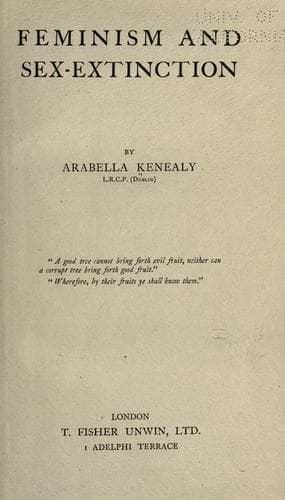
Feminism; Women; Women -- Social and moral questions; Women -- Social conditions
Since by his dual constitution, moreover, man possesses, by inheritance
from his mother, the quotum of woman-apprehension, foresight, and
altruism required to present the woman-bent and view-point in his
outlook and conduct of political and civic affairs, woman's personal
intervention in these is as superfluous as it would be harmful.
Further, there are two orders of men: An order strictly male in trend
and talent, and an order whose mentality is tinctured with a higher than
average proportion of womanly conservatism, sympathy and intuition. And
these two orders of male--typified, respectively, by the Conservative
and the Radical parties--perpetually struggling to secure the measures
prompted by their respective orders of mind, and intermittently gaining
ascendancy, sustain a poise, or mean, between the unduly conservative
and traditional, and the unduly radical and transitional in our
political administration.
These two orders of mentality are found again in Youth and Age. All
healthy and vigorous-minded young men are radical of bias; hot-headed,
precipitate and intolerant of crusted orthodoxy, keen to demolish old
institutions and established methods. While maturity makes for
conservatism. It _knows_. And having learned by experience the values of
institutions which have become institutions because of their values, it
is prudent in its counsels of slow and stable reform, in its distrust of
drastic, precipitate change, and, beyond all, in its wise misdoubtings
of the world in general as being better than it is, and ripe,
accordingly, for the best things.
For the present, there are numberless problems and questions of women's
industrial employment, of children's employment, of the industrial
supervision of young girls and their moral protection; problems of
female drunkenness and prostitution, crimes of children, crimes against
infants and children; questions of health, of the education and
upbringing of the young, of dress and conduct, and of the general moral
purification and the mental elevation of the Race--with all of which
women are essentially qualified to deal; and the vital national
importance whereof men have proved themselves as incapable of
apprehending as they have shown themselves powerless to administer them.
The two classes of national problems, or the two departments into which
most of these problems might be advantageously sub-classed, should be
recognised as being the functions, respectively, of the one or of the
other sex, and should be deputed for consideration to the House of Men
or to the House of Women. With the result that in both, every problem of
reform would be dealt with by the sex specialised by nature, by
sympathy, and by training, best to understand and best to legislate for
it.
As with The Lords, either House should have power to question or to
reject the conclusions of the other.
Public-domain text, read in full here on John Shaqi.
Reviews
Reviews
No reviews yet
Be the first to share your thoughts on this work.
Elsewhere in the archive
Join the Discussion
Join the discussion
Sign in to leave a comment or review.
Sign InorCreate an account