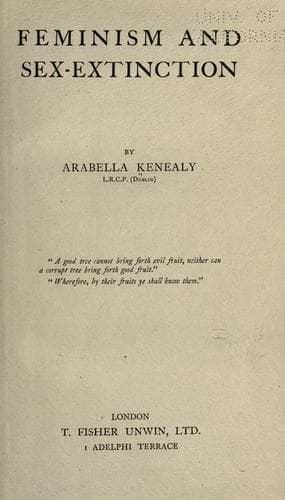
Feminism; Women; Women -- Social and moral questions; Women -- Social conditions
The spirit and pride of Sex are normal and inspiring, and are the
expression of that impulse which has directed, in both sexes, the
contrary trend of both. No man of mettle feels ever again the same zest
or spur to achievement in a rôle that has become equally woman's.
Arrogance? Possibly. But wholesome and energising. Defect of that pride
in his man's mission which inspired Drake, Columbus, Nelson, Cæsar,
Shakespeare, Newton, to great conquest. Without it, man ceases to be
man. That it is a factor to be reckoned with, was proved by the recent
election, which was signalised by being woman's first authorised entry
into the political arena--and was characterised by nothing so much as by
man's indifference, even his neglect to record his vote. And that it is
a factor to be reckoned with, is further and seriously proved by the
slackness and diminished zest and output of masculine Labour, since the
other sex has invaded the field.
Woman, for her part, is characterised by a similar spirit and pride of
her sex. Equally she loses it when men intrude upon her province. And
this Sex-pride and spirit in her would be nobly intensified and uplifted
to ever higher levels of expression and attainment, were she but assured
of the fine quality and issues of those woman-faculties and functions,
by way of which it is her privilege first to create Life, and afterwards
to minister to it.
A potent factor in man's impotence to hold his own either in moral or
achievement, when pitted directly against the other sex, is that power
many women exercise of recruiting their vital forces from those of
persons--and of men, particularly--in association with them. The highest
levels of work and inspiration are the product of _reserve_ and surplus
forces. When these are depleted, only languid and lower-grade aims and
capacities are possible.
The extent to which over-worked women may impair the health and
constitutional vigour of men associated with them in work was strikingly
shown during the changed conditions of War. Surrounded by over-wrought
girls and women, who kept themselves going by stimulus of nervous
excitement, of strong tea or more dangerous drugs, many men, co-workers
or heads of departments, became neurasthenic wrecks. Others lapsed to
the condition of infirm old men. The like was seen in fathers and
husbands of such over-wrought War-workers. And nervous depletion
occasioned by working-wives has doubtless much to do with the inanition
and depression now crippling our industrial output.
Public-domain text, read in full here on John Shaqi.
Reviews
Reviews
No reviews yet
Be the first to share your thoughts on this work.
Elsewhere in the archive
Join the Discussion
Join the discussion
Sign in to leave a comment or review.
Sign InorCreate an account