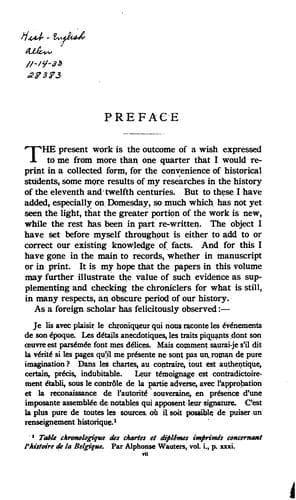
Feudal England: Historical Studies on the Eleventh and Twelfth CenturiesRound, John Horace
History
Feudal England: Historical Studies on the Eleventh and Twelfth Centuries
Round, John Horace
Domesday book; Feudalism -- Great Britain; Great Britain -- History -- Norman period, 1066-1154; Normans -- Great Britain
[Footnote 196: I know of no authority for this form.]
[Footnote 197: The '_Lathes_' of Kent of course point in the
same direction.]
[Footnote 198: Professor Vinogradoff states, on the contrary,
that 'all are irregular in their formation'.]
[Footnote 199: _English Village Community_, pp. 54, 139, 396.]
[Footnote 200: The phrase 'quot hidæ _sint_ ibi' is of
importance because such _formulae_ as 'T.R.E. geldabat pro ii.
hidis, sed tamen _sunt_ ibi xii. hidæ', have sometimes been
understood to imply two geldable, but twelve arable hides,
whereas both figures refer to assessment only.]
[Footnote 201: _English Village Community_, 212 note.]
[Footnote 202: We might also compare the _droit de gîte_ on
the other side of the Channel.]
[Footnote 203: I am indebted for these identifications to Mr
Eyton's work.]
[Footnote 204: It is a further and fundamental error that
Mr Eyton speaks of the _firma unius noctis_ as 'borough
taxation', whereas it was essentially of the nature of rent,
not taxes.]
[Footnote 205: I am indebted for these identifications to Mr
Eyton's work.]
[Footnote 206: We should perhaps read this as explaining
the composition of the centuriatus, viz.: 'the priests, the
reeves, and six villeins from each Vill'.]
[Footnote 207: Of this conflict there is a good instance,
almost at the outset of the Cambridgeshire survey (p. 3):
'Hanc terram posuit Orgarus in vadimonio ... ut homines
Goisfridi dicunt. Sed homines de hundredo neque breve
aliquid neque legat' R.E. inde viderunt, neque testimonium
perhibent.']
[Footnote 208: Whittlesford omitted, because in this Hundred
no lands were held or claimed by the Abbey.]
[Footnote 209: Compare Wilkins, 125 (quoted by Palgrave,
_English Commonwealth_, i. 464) on English and 'Welsh' in
Devon: 'Disputes arising between the plaintiffs and defendants
of the two nations were to be decided by a court of twelve
"lawmen"--six English and six Welsh--the representatives of
the respective communities. And it may be observed that
the principle which suggested this dimidiated tribunal was
generally adopted in our border law.']
[Footnote 210: Wharton's _Anglia Sacra_, i. 339.]
[Footnote 211: Palgrave's _Commonwealth_, ii. 183.]
[Footnote 212: This seems of great importance as a very early
instance of the _quatuor villatæ_ system, on which see Gross's
'The Early History and Influence of the Office of Coroner'
(_Political Science Quarterly_, vol. vii, No. 4), where the
researches of Prof Maitland and others are summarized.]
[Footnote 213: Only four, however, of the fourteen actually
swore: 'reliquos vero decem quietavit Willelmus abbas, qui
parati erant jurare'.]
Public-domain text, read in full here on John Shaqi.
Reviews
Reviews
No reviews yet
Be the first to share your thoughts on this work.
Elsewhere in the archive
Join the Discussion
Join the discussion
Sign in to leave a comment or review.
Sign InorCreate an account