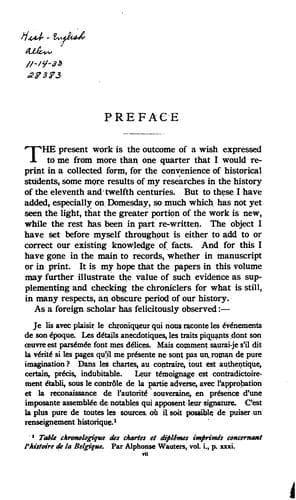
Feudal England: Historical Studies on the Eleventh and Twelfth CenturiesRound, John Horace
History
Feudal England: Historical Studies on the Eleventh and Twelfth Centuries
Round, John Horace
Domesday book; Feudalism -- Great Britain; Great Britain -- History -- Norman period, 1066-1154; Normans -- Great Britain
[Footnote 16: It is singular that in Sussex the 'Cloninctune'
of Domesday is, conversely, an error for 'Doninctune'. The
source of the error in both cases must have been the likeness
of 'cl' to 'd' in the original returns, on which these names
cannot have begun with a capital letter.]
[Footnote 17: _Rot. Pip._, 31 Hen. I.]
THE INTRODUCTION OF KNIGHT SERVICE INTO ENGLAND[1]
'The growth of knighthood is a subject on which the greatest
obscurity prevails; and the most probable explanation of its
existence in England, the theory that it is a translation into
Norman forms of the thegnage of the Anglo-Saxon law, can only
be stated as probable.'--STUBBS, _Const. Hist._, i. 260.
In approaching the consideration of the institutional changes and
modifications of polity resulting from the Norman Conquest, the
most conspicuous phenomenon to attract attention is undoubtedly the
introduction of what it is convenient to term the feudal system.
In the present paper I propose to discuss one branch only of that
process, namely, the introduction of that military tenure which
Dr Stubbs has termed 'the most prominent feature of historical
feudalism'.
In accordance with the anticataclysmic tendencies of modern thought,
the most recent students of this obscure problem have agreed to adopt
the theory of gradual development and growth. The old views on
the subject are discredited as crude and unhistorical:[2] they are
replaced by confident enunciation of the theory to which I have
referred.[3] But when we examine the matter closely, when we ask for
details of the process by which the Anglo-Saxon thegn developed into
the Norman knight, we are met at once by the frank confession that
'between the picture drawn in Domesday and the state of affairs which
the charter of Henry I was designed to remedy, there is a difference
which the short interval of time will not account for'.[4] To meet
this difficulty, to account for this flaw in the unbroken continuity
of the series, a _Deus ex machinâ_ has been found in the person of
Ranulf Flambard.
Public-domain text, read in full here on John Shaqi.
Reviews
Reviews
No reviews yet
Be the first to share your thoughts on this work.
Elsewhere in the archive
Join the Discussion
Join the discussion
Sign in to leave a comment or review.
Sign InorCreate an account