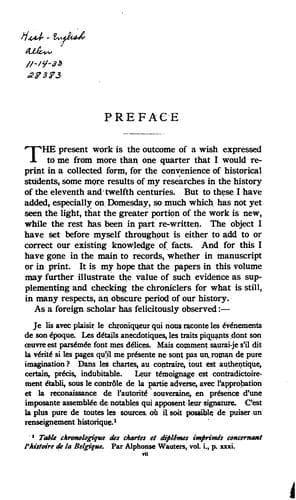
Feudal England: Historical Studies on the Eleventh and Twelfth CenturiesRound, John Horace
History
Feudal England: Historical Studies on the Eleventh and Twelfth Centuries
Round, John Horace
Domesday book; Feudalism -- Great Britain; Great Britain -- History -- Norman period, 1066-1154; Normans -- Great Britain
On the institution of 'scutage' there has been much misconception.
It is placed by our historians among the great innovations wrought by
Henry II, who is supposed by them to have introduced it in 1156.[121]
Here we see, once again, the danger of seeking our information on such
points secondhand, instead of going straight to the fountainhead for
ourselves.
John of Salisbury implies that scutage was no novelty in 1156 when he
writes, not that the king imposed it, but that he '_could not remit_
it'. This inference is at once confirmed by the appearance of scutage
_eo nomine_ in the reign of Henry I.
The following charter is found in the (MS.) _Liber Eliensis_ (Lib.
III), No. xxi, and in the Cottonian MS. Nero A. 15:
H. rex Anglorum Archiepiscopis, Episcopis, Abbatibus,
Comitibus, etc. Salutem. Sciatis me condonasse Ecclesiæ S.
Ætheldredæ de Ely pro Dei amore et anima Patris et Matris
meae et pro redemptione peccatorum meorum, et petitione Hervei
ejusdem Ecclesie Episcopi 40 libras de illis 100 libris
quas predicta Ecclesia solebat dare de _Scutagio_ quando
_Scutagium_ currebat[122] per terram meam Anglie: ita quod
Ecclesia amodo inperpetuum non dabit inde nisi 60 libras
quando _Scutagium_ per terram evenerit, et ita inperpetuum
sit de predictis libris Ecclesia predicta quieta. T. Rogero
Episcopo Saresberiensi, Gaufrido Cancellario meo et Roberto
de Sigillo et Willelmo de Tancarvilla et Willelmo de Albineio
Pincerna et Radulfo Basset et Gaufrido de Clintona et Willelmo
de Pondelarche. Apud Eilinges in transitu meo.
This is followed by (No. xxii) a grant of Chatteris Abbey to the
church of Ely;[123] and this again is followed, in a register of
Chatteris Abbey,[124] by a remission of 6s 7d Wardpenny hitherto
paid by that abbey. The first and third charters receive singular
confirmation, being thus accounted for in the Pipe-Roll of Henry I:
Et idem Episcopus debet ccxl. li. ut rex clamet eum quietum
de superplus militum Episcopatus, et ut Abbatia de Cateriz sit
quieta de Warpenna (p. 44).
This entry, moreover, connects the _scutagium_ with the system of
knight-service (_superplus militum_).
It is delicious to learn, on comparing the records, that the virtuous
king who made these grants for the weal of his parents' souls and the
remission of his own sins, extorted from the church, for making them,
an equivalent in hard cash.[125]
Public-domain text, read in full here on John Shaqi.
Reviews
Reviews
No reviews yet
Be the first to share your thoughts on this work.
Elsewhere in the archive
Join the Discussion
Join the discussion
Sign in to leave a comment or review.
Sign InorCreate an account