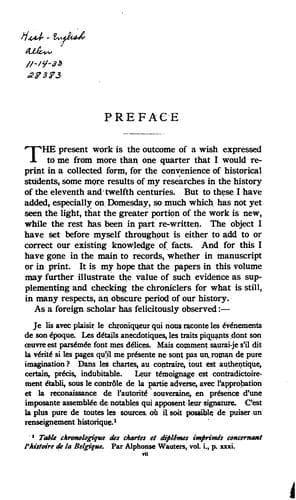
Feudal England: Historical Studies on the Eleventh and Twelfth CenturiesRound, John Horace
History
Feudal England: Historical Studies on the Eleventh and Twelfth Centuries
Round, John Horace
Domesday book; Feudalism -- Great Britain; Great Britain -- History -- Norman period, 1066-1154; Normans -- Great Britain
How strangely different from these wild figures are the sober facts
of the case! The whole of the church fiefs, as we have seen, were
only liable to find 784 knights, a number which, small as it was, just
exceeded the entire knight service of Normandy as returned in 1171. As
to the lay fiefs it is not possible to speak with equal confidence. I
have ventured to fix the approximate _quota_ of 104 (more or less),
of which ninety-two are in favour of my theory: forty-eight fiefs, of
five knights and upwards, remain undetermined.[200] If the average of
knights to a fief were the same in the latter as in the former class,
the total contingents of the lay barons would amount, apparently, to
3,534 knights; but, as the latter one includes such enormous fiefs as
those of Gloucester and of Clare, with such important honours as those
of Peverel and Eye, we must increase our estimate accordingly, and
must also make allowance for fiefs omitted and for those owing less
than five knights (which are comparatively unimportant).
Making, therefore, every allowance, we shall probably be safe in
saying that the whole _servitium debitum_, clerical and lay, of
England can scarcely have exceeded, if indeed it reached, 5,000
knights.
Indefinite though such a result may seem, it is worth obtaining for
the startling contrast which it presents to the 60,000 of Ordericus,
to the 32,000 of Segrave,[201] and to the 30,000 of Gneist. The only
writer, so far as I know, who has approximated, by investigating
for himself, the true facts of the case, is Mr Pearson;[202] but his
calculations, I fear, are vitiated by the unfortunate guess that the
alleged 32,000 fees were really 6,400 of five hides each. It is a
hopeless undertaking to reconcile the facts with the wild figures
of mediæval historians by resorting to the ingenious devices of
apocalyptic interpretation.
V. THE NORMAL KNIGHT'S FEE
Much labour has been vainly spent on attempts to determine the true
area of a knight's fee. The general impression appears to be that
it contained five hides. Mr Pearson, we have seen, based on that
assumption his estimate of 6,400 fees, and other writers have treated
the fee as the recognized equivalent of five hides. The point is of
importance, because if we found that the recognized area of a knight's
fee was five hides, it would give us a link between the under-tenant
(_miles_) and the Anglo-Saxon thegn. But, as Dr Stubbs has recognized,
the assumption cannot be maintained; no fixed number of hides
constituted a knight's fee.
Public-domain text, read in full here on John Shaqi.
Reviews
Reviews
No reviews yet
Be the first to share your thoughts on this work.
Elsewhere in the archive
Join the Discussion
Join the discussion
Sign in to leave a comment or review.
Sign InorCreate an account