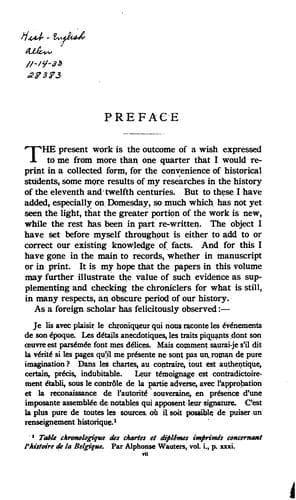
Feudal England: Historical Studies on the Eleventh and Twelfth CenturiesRound, John Horace
History
Feudal England: Historical Studies on the Eleventh and Twelfth Centuries
Round, John Horace
Domesday book; Feudalism -- Great Britain; Great Britain -- History -- Norman period, 1066-1154; Normans -- Great Britain
Two issues--quite distinct--are involved. In the first place, Mr
Seebohm contends that Professor Vinogradoff must not argue from 'the
custom of Kent' to the rest of England, because (_inter alia_) Kent,
unlike the rest of England, was divided into _sulungs_, which points
to some difference in its organization.[197] This contention is sound,
and is actually strengthened if we reject the identity of _sulung_ and
_solanda_. But, in the second place, he endeavours to explain away
the Essex case of subdivision at Eadwulfsness, to which the Professor
appeals, by connecting it with the Kentish system through the term
_solanda_. This, as I have shown above, is based on a misreading of
the evidence, and is contrary to the facts of the case.
Let us then look more closely at the Essex instance of subdivision.
It is taken from one Manor alone, the great 'soke' of Eadwulfsness,
in the north-east corner of the county. This 'soke' comprised the
townships of Thorpe 'le soken', Kirby 'le soken', and Walton 'le
soken' (better known as Walton-on-the-Naze). Such names proclaim
the Danish origin of the community, and it is noteworthy that the
'hidarii', on whom the argument turns, are found only at Thorpe
and Kirby, the very two townships which bear Danish names. This
circumstance points to quite another track. That the system in this
little corner of Essex was wholly peculiar had been pointed out by
Hale, and it might perhaps have originated in the superimposition of
hides on a previous system, instead of in the breaking up of the hide
and virgate system. But this is only a conjecture. The two facts on
which I would lay stress are that at Thorpe, according to Hale,
'the holders of the nine hides (in 1279) possessed also among them
seventy-two messuages', which, by its proportion of eight to the hide,
favours Mr Seebohm's views; and that the holdings of the 'hidarii'
were rigidly formed on the decimal system (such as 60, 30, 15, 7-1/2
acres, or 40, 20, 10, 5 acres),[198] unlike the holdings of an odd
number of acres on the Kentish Manors of St. Augustine's. The reason
for the Essex system was clearly the necessity of keeping the holdings
in a fixed relation to the hide, that their proportion of the hide's
service might be easily determined. These two points have, perhaps,
I think, been overlooked by both of the eminent scholars in their
controversy.
Public-domain text, read in full here on John Shaqi.
Reviews
Reviews
No reviews yet
Be the first to share your thoughts on this work.
Elsewhere in the archive
Join the Discussion
Join the discussion
Sign in to leave a comment or review.
Sign InorCreate an account