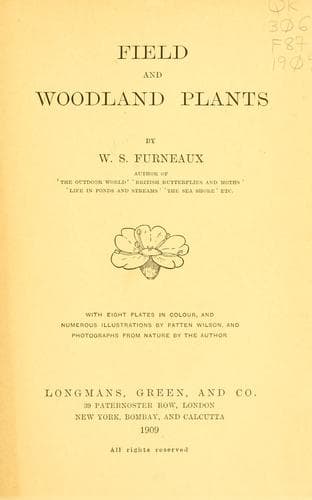
Plants -- Identification; Wild flowers -- Great Britain
A few minutes later the filaments of the leaf immediately around the
insect begin to bend towards it, and others a little farther off soon
partake in the movement, which may finally extend more or less to all
the filaments of the leaf, and thus a large number of glands are brought
in contact with the prey. The process of digestion now goes on, and, in
a day or two, all the digestible portions of the insect are dissolved
and absorbed, and the filaments that were concerned in the work have
resumed their original position, leaving the indigestible portions to
dry and to be eventually blown away.
The principal food of the Sundews consists of small insects such as
ants, midges, flies, small butterflies and moths, caddis-flies, and even
small species of dragon-flies. Some of these, more particularly the
long-bodied dragon-flies, the smallest of which are over an inch in
length, are much too large to be caught and devoured by a single leaf;
and in this case it is not at all uncommon for two or more leaves to be
concerned in the capture and digestion of a single insect, each one
converging its filaments towards the part of the body within its reach,
and each one digesting and absorbing the portion against which it can
apply its glands.
Insects, however, do not constitute the sole food of these plants, for
small worms, spiders, centipedes, &c., are caught and digested in the
manner described; and the plants may also be fed artificially on small
pieces of meat or other nitrogenous substances, which give rise to the
same processes and movements as we have observed in connection with the
natural mode of feeding.
LIST OF FLOWERS
CLASSIFIED ACCORDING TO THEIR HABITATS AND HABITS
The following list of wild flowers, classified according to their habits
and principal habitats, will assist the student in his attempts to
identify unknown species. A general acquaintance with the chief
distinguishing features of the orders, or, failing this, a frequent
reference to these features as given in Chapter I, will be a valuable
help; and, the order once determined, the few particulars added to each
name will generally narrow the search down to one or two species,
leaving the final decision to the more detailed description given in the
text.
The first number given after each name is the height, or, in the case of
climbing and trailing species, the length of the plant; and this is
followed by the colour and diameter, of the flower, or, in the case of
the _Dipsaceæ_, _Compositæ_, and some other plants in which the flowers
are densely clustered, the diameter of the cluster or head.
Abbreviations are used as follows:--
W. = white
Y. = yellow
G. = green
R. = red
P. = pink
C. = crimson
V. = violet
Bl. = blue
Br. = brown
Pu. = purple
Cr. = cream
Li. = lilac
Ro. = rose
O. = orange
Sc. = scarlet
p. = pale
d. = dark or deep.
Public-domain text, read in full here on John Shaqi.
Reviews
Reviews
No reviews yet
Be the first to share your thoughts on this work.
Elsewhere in the archive
Join the Discussion
Join the discussion
Sign in to leave a comment or review.
Sign InorCreate an account