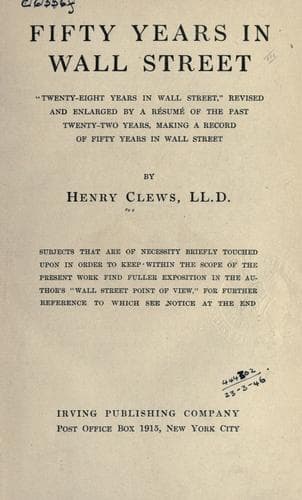
Business; Capitalists and financiers -- United States; Speculation; Wall Street (New York, N.Y.)
It goes without saying that Drew was the most unique figure that Wall
Street has ever seen, and a characteristic specimen of one kind of
American thrift, enterprise and speculation. Every side of his
many-sided and peculiar character, therefore, is of interest as the
representative of a class to the reader who sets his heart on making
money, and the majority of readers have this weakness. He is of special
interest to all speculators not only in this country, but throughout the
civilized world. These facts constitute my apology for dwelling so long
and minutely on his characteristics. I have an idea that his life and
adventures will be read with deep interest many years hence, and help to
prolong the existence and reputation of this book. They will also assist
to immortalize the man who was one of the most wonderful products of
American civilization, and who could hardly have been evolved from any
other soil or clime. Such prodigies of success cause the members of the
older social fabrics to stare with astonishment at the stupendous
capabilities of our great country.
There is nothing interests people so much as the start in life, probably
because there are so few who consider themselves able to get a good
start. So far as I can learn, in the case of Daniel Drew, the boy was
father to the man. He worked on a farm, going to school at intervals,
where he was unable to learn anything, except that he obtained a notion
of the current theological ideas of that day, until he was fifteen years
of age, when his father died, leaving him, a younger brother and their
mother to shift for themselves on a poor, small farm. His father was of
English and his mother of Scotch descent.
In his seventeenth year young Drew enlisted as a substitute in the State
Militia, which had then been called into service on account of the
second war with England.
The regiment was placed at Fort Gansevoort, on the Hudson, opposite New
York. Hostilities ceased between this country and England a few months
after his enlistment, and the regiment was mustered out. Daniel returned
home. His mother had taken charge of his substitute money, which
probably did not exceed a hundred dollars, the amount with which his
great rival, Commodore Vanderbilt commenced life, and which he earned
from his mother by ploughing and planting a field.
“I want my substitute money,” said Drew to his mother, one day shortly
after his return. “What are you going to do with it?” queried the old
woman, for being of Scotch descent, she was quite as thrifty in looking
after the pennies as her American contemporary, old Mrs. Vanderbilt.
They both had the gripping sense by nature, and to this transmissible
quality may probably be attributed, in a large degree, the financial
success of both of their sons.
“I am going to buy cattle, and sell them in New York,” replied Daniel.
“Are you sure you will not lose money by it?” rejoined his mother.
“I am sure I will make money,” he said.
Public-domain text, read in full here on John Shaqi.
Reviews
Reviews
No reviews yet
Be the first to share your thoughts on this work.
Elsewhere in the archive
Join the Discussion
Join the discussion
Sign in to leave a comment or review.
Sign InorCreate an account