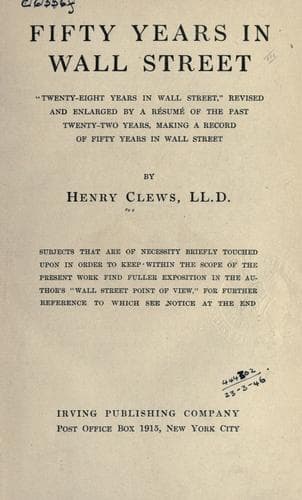
Business; Capitalists and financiers -- United States; Speculation; Wall Street (New York, N.Y.)
He went out to Putnam county in 1876, when he was sick, but he was soon
glad to get back to the city. He said: “I was troubled with visitors,
some of ’em well on to 100 years old. Some of them said I bought cattle
from them when I was young, on credit, and they wanted their bills. I
kept no books, and how was I to know I owed ’em for them critters? It
was dull outen thar,” he continued, “and yer never can tell till the
next day how ‘sheers’ is gone.”
So Uncle Daniel came back and stopped at the Hoffman House, where he
could have ready access to the ticker, and kept constantly posted on the
price of stocks. His principal broker was Mr. David Groesbeck.
The city still seemed to have certain fascinations for him that the
country was unable to afford. He often spoke regretfully, in his latter
days, of being too old to retrieve his fortune. He said he longed for
rest. Nothing seemed to weigh more heavily upon his mind than his
inability to carry out the plans connected with his religious
endowments, and he grieved deeply that he had not the means to return to
Wall Street that he might have another lucky turn that would enable him
to fulfil these religious obligations according to the original
intention.
In the bankruptcy schedule his personal property is itemized as follows:
watch and chain, $150; sealskin coat, $150; wearing apparel, $100;
Bible, hymn books, &c., $130.
Although he was economic in his domestic expenses, he entertained
friends liberally, and his house at the southwest corner of Seventeenth
street and Union Square was always open to Methodist ministers, free of
charge, from all quarters of the world.
Some years prior to his death Mr. Drew gave the following candid,
succinct and pathetic account of his embarrassment to a journalist who
interviewed him:
“I had been wonderfully blest,” said Uncle Daniel, “in money making. I
got to be a millionaire before I knowed it hardly. I was always pretty
lucky till lately. I didn’t think I could ever lose money extensively. I
was ambitious of making a great fortune, like Vanderbilt, and I tried
every way I knew, but got caught at last. Besides that, I liked the
excitement of making money, and giving it away, and am glad of it. So
much has been saved anyhow. Wall Street was a great place for making
money, and I could not give up the business when I ought to have done
so. Now, I see very clearly what I ought to have done. I ought to have
left the Street eight or ten years ago, and paid up what I owed. When I
gave $100,000 to this institution and that, I ought to have paid the
money, and I ought to have provided better for my children, by giving
them enough to make them rich for life. Instead of that I gave my notes,
and only paid the interest on ’em, thinking I could do better with the
principal myself. One of the hardest things I have had to bear has been
the fact that I could not continue to pay the interest on the notes I
gave to the schools and churches.”
Public-domain text, read in full here on John Shaqi.
Reviews
Reviews
No reviews yet
Be the first to share your thoughts on this work.
Elsewhere in the archive
Join the Discussion
Join the discussion
Sign in to leave a comment or review.
Sign InorCreate an account