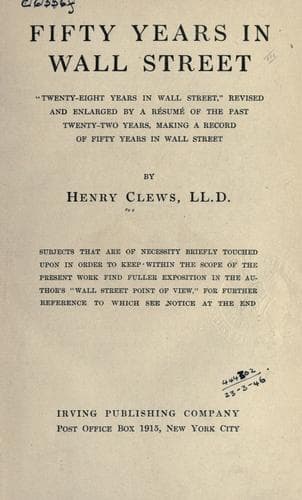
Business; Capitalists and financiers -- United States; Speculation; Wall Street (New York, N.Y.)
But, unfortunately, the law imposes restraints upon the national banks
which seriously interfere with the wise discretion of those
institutions. As the law now stands, the banks are liable to be wound up
at the order of the Government if they permit their lawful money
reserves to fall below 26 per cent. of their legal deposits. This
establishes a “dead line” which is so dreaded when approached that it
becomes almost a panic line. When that limit is reached, the banks are
compelled to contract their loans; and, in certain conditions, the
contraction of loans means forcible liquidation, without regard to
consequences. Thus the very contrivance designed to protect the banks
becomes a source of most serious danger to their customers and therefore
to the banks themselves; and, in times of monetary pressure, it is the
most direct provocative of panic. Were the banks allowed to use their
reserves under such circumstances, a fund would be provided for
mitigating the force of the crisis, and the danger might be gradually
tided over; but, as it is, the banks can legally do little or nothing to
avert panic; on the contrary, the law compels them to take a course
which precipitates it; and when the crash has come, they have to unite
in common cause to disregard the law and do what they can to repair the
catastrophe that a preposterous enactment has helped to bring about.
This is one of not a few unwise restrictions upon our national banks
which needs to be stricken from the statute book. These periods of the
breaking-down of unsound enterprises and of the weeding out of insolvent
debtors and of liquidation of bad debts can never be wholly averted; nor
is it desirable that they should, for they are essential to the
maintenance of a sound and wholesome condition of business; but it is a
grave reproach to our legislators if, when the day of purgation comes,
the law treats the deserving and the undeserving with equal severity.
GEORGE I. SENEY.
The most prominent characters in the short lived panic of 1884, as every
observing person knows, were Ferdinand Ward, James D. Fish and a few
others who acted minor parts in connection with the methods of
financiering which precipitated the crisis in Wall Street.
There are many people who think that Ward—the Young Napoleon of finance,
as he was popularly called—was able to dupe everybody, his accomplices
included, and that he was chiefly responsible for all the trouble. But
this is an exaggerated and unscientific view of the case.
Public-domain text, read in full here on John Shaqi.
Reviews
Reviews
No reviews yet
Be the first to share your thoughts on this work.
Elsewhere in the archive
Join the Discussion
Join the discussion
Sign in to leave a comment or review.
Sign InorCreate an account