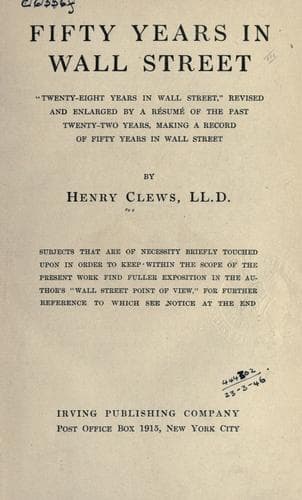
Business; Capitalists and financiers -- United States; Speculation; Wall Street (New York, N.Y.)
The transactions of the four prominent speculators who played the most
conspicuous part in the events which resulted in the panic of May, 1884,
should be preserved for reference, as a guide when similar cases arise,
for in spite of the deep disgrace, shame and misery that have followed
in the wake of their enterprises, these men will have hosts of imitators
for many years to come. Ward, Fish, Seney and Eno, with probably the one
exception, Fish, are, by many, considered smart men, who simply had the
misfortune to become involved, but who had a fair chance of coming out
of all their troubles, great millionaires and publicly honored for their
ability and success.
It must be admitted that there are some examples in the financial world
whose careers will fully support this theory and belief but they are the
exceptions which only prove the rule in speculation, as in other lines
of business, that “honesty is the best policy.” These men, who have been
apparently so successful through dishonest methods, are never free from
dread of being tripped up at any period of their inflated prosperity.
They are always subject to be called upon by the application of the
stern methods of honest financiering to give an account of their
stewardship, and to have the transactions of a lifetime eventually
gauged by the standard of public honesty. It is the winding up that
tells the tale, and exposes the duplicity of the ablest financiers, who
vainly imagine that dishonest methods will always prevail.
JOHN C. ENO.
Of the four famous “financiers” mentioned who were most prominent in the
Summer panic of 1884, the speculative history of John C. Eno was in some
respects the most remarkable and most interesting.
Eno was a young man, not more than twenty-six years of age, and a
representative of that class of ardent and youthful speculators who
plunge into the market with all the recklessness incident to young and
sanguine imaginations, with many roseate schemes of wealth and
greatness, for which inexperienced youth is proverbial. Eno was a victim
of that rashness, impulsiveness and desire for extravagance, by which
the possessors of these attributes frequently get themselves and many of
their associates embroiled in numerous difficulties and embarrassments.
Another point of interest in the curious career of Eno was his position
as President of the Second National Bank of New York, up to the time of
the panic. Seldom does it fall to the lot of a youth of his tender years
to have conferred upon him a position of such responsibility and
dignity. The manner in which he made use of this position of trust, for
appropriating money which did not belong to him, was notable for its
peculiar ingenuity.
Most of the money lent by the bank was upon collateral securities,
which, for convenience, as well as for safety, were kept, not at the
bank, which was situated under the Fifth Avenue Hotel, but in a vault
down town.
Public-domain text, read in full here on John Shaqi.
Reviews
Reviews
No reviews yet
Be the first to share your thoughts on this work.
Elsewhere in the archive
Join the Discussion
Join the discussion
Sign in to leave a comment or review.
Sign InorCreate an account