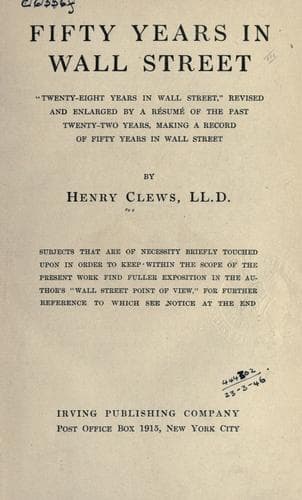
Business; Capitalists and financiers -- United States; Speculation; Wall Street (New York, N.Y.)
In this panic the boldest and most remarkable instance of self-sacrifice
on record was manifested by the Clearing-House banks. The panic of 1884,
in its incipient stage, was different to any that had preceded it—at
least any of the financial convulsions within my recollection—owing to
the influence exercised upon it by the prompt and liberal policy of the
banks. In every respect their action was notable, showing that those at
the head of their management had largely profited by the lessons of
former panics.
It was chiefly due to the masterly management of the banks, together
with the magnanimous conduct of Mr. Amos R. Eno and his associate
directors of the Second National Bank, that the panic was short-lived
and so narrowly circumscribed. Had it not been for the determinate and
instantaneous joint action of these parties there would have been a very
serious crash, which would have been far-reaching in its results.
The results of the timely action taken on the part of the managers of
these institutions in this crisis, proves that panics can be arrested by
proper methods, and that quick and determined action is indispensable in
the incipient stage of the emergency. If bank presidents could only be
relied upon by the business community to act promptly and in unison with
the business men, as they did in this instance, threatened panics need
have but little terror for the people, who now live constantly in dread
that these outbursts of business disaster may be sprung upon them at any
time in any decade.
In the past history of panics bank managers, as a rule, have acted
without system, without judgment and almost entirely without any well
defined plan of action. There has been an astonishing lack of vigor in
their methods and purposes, which were weak and vacillating in their
character—frequently more like the acts of children than those of
business men.
If the panic of 1873 had received the same vigorous treatment in its
origin as that of 1884, it could just as easily have been checked as the
latter, and the entire country would have been saved a large portion of
the depressing effects of that serious collapse and its attendant
disasters, which caused a state of general prostration for five or six
years succeeding the event. These years, from a business standpoint,
appear as a blank in the history of the country’s progress. Indeed, they
constitute a black mark.
Public-domain text, read in full here on John Shaqi.
Reviews
Reviews
No reviews yet
Be the first to share your thoughts on this work.
Elsewhere in the archive
Join the Discussion
Join the discussion
Sign in to leave a comment or review.
Sign InorCreate an account