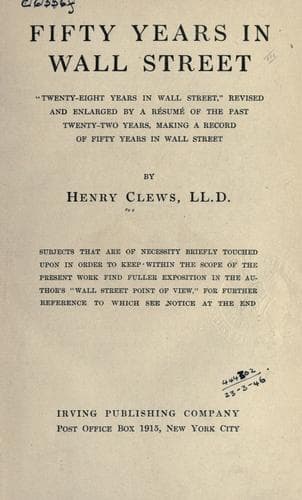
Business; Capitalists and financiers -- United States; Speculation; Wall Street (New York, N.Y.)
Equally is the man to be commiserated who, from a constitutional
intoxication of hope, keeps on buying and holding when it is manifest
that the country has passed the summit of an era of prosperity and is
destined to a general reaction in trade and values. Of course, such men
never remain long in Wall Street; their pockets are soon emptied, and
they retire to reflect on the folly of refusing to appreciate and to
follow the natural drift of the conditions that regulate values.
A minor source of losses lies in operating at times when the market is
so evenly balanced between opposing forces that there is no chance for
making profits. At such times, operators get disgusted at the
sluggishness of the market; they change their holdings from day to day,
with no advantage except to their broker; and their monthly statement
shows a heavy list of charges for interest and commissions, with no
offset of profits. These intervals of stagnancy sometimes run for weeks,
sometimes for months; and at such times a wise speculator would take
care to keep out of the market and hold himself in readiness for
anything that may turn up.
It is necessary to the avoidance of loss that the operator should
maintain an intelligent watch upon the influences that control the
market. Those influences are two-fold—such as are intrinsic to the
market, and such as are external to it. Of the former class are those
that relate to the spirit and tone of the market; the position and
disposition of the cliques; the action of the large operators; the
overloaded or over-sold state of the market, as indicated by the loaning
rates for stocks; the influence exerted by the upward or downward
movements in stocks which at the moment are specially active; the
possibility of closing out holders on “stop orders” or on the impairment
of margins; the unloading of influential cliques and the covering of
important lines of short sales, &c., &c. Influences of this kind are
very frequently sufficient of themselves to control the market for a
considerable period in direct opposition to the tendency indicated by
external conditions. It is, however, no easy matter to form a correct
conclusion as to the drift resulting from this set of factors. They are
so concealed and so changeful, and the symptoms are so vague, that it
requires long experience, added to unusual sagacity, to determine what
may be the tendency resulting from the complex action and counteraction
of this set of conditions. Some exceptional operators enjoy an
instinctive faculty for weighing these shadowy indications with almost
unerring certainty. Such men usually care little about outside
influences, except so far as they may affect the market for the moment.
From the nature of the case, their transactions are apt to be brief
ones, and follow quickly the momentary course of the market They are
reckoned among the most sagacious speculators, and are usually very
successful. But their success is the result of a special natural gift,
Public-domain text, read in full here on John Shaqi.
Reviews
Reviews
No reviews yet
Be the first to share your thoughts on this work.
Elsewhere in the archive
Join the Discussion
Join the discussion
Sign in to leave a comment or review.
Sign InorCreate an account