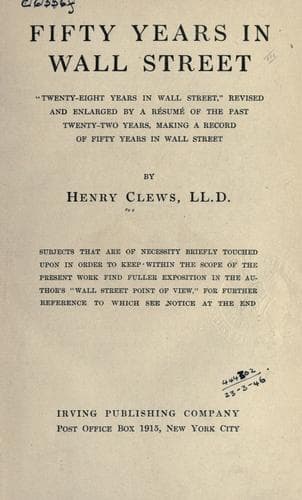
Business; Capitalists and financiers -- United States; Speculation; Wall Street (New York, N.Y.)
In 1877 Mr. Keene started on a voyage for Europe for the good of his
health, and made a friendly call in Wall Street to see how business was
transacted there. He found the speculative attraction irresistible.
Mahomet had come to the mountain and was held by its magnetic power.
Although Mr. Keene had been a grand success in California, he had a good
deal to learn when he came to Wall Street. He soon discovered that
California tactics would not do here. He began to sell “short,” but
found the market failed to yield to the touch of his bearish wand as it
had done in San Francisco. When he sold ten thousand shares of a certain
stock the decline, instead of being a slump, as he expected, was only an
insignificant fraction, and the market soon reacted. Mr. Keene quickly
discovered that he was throwing water into a sieve, and stopped
sacrificing his California gold so lavishly.
A pool was then formed by Mr. Keene and Jay Gould to put down Western
Union. Keene and Selover sold the stock in large blocks, but it was
absorbed by some party or parties unknown as fast as it was thrown out.
It was gravely suspected that Mr. Gould was the wicked partner who was
playing this absorbing game behind the scenes. Major Selover brooded
over the matter so seriously that his suspicions began to take tangible
form and “body themselves forth” in violence.
The Major and Keene met one morning at the rear entrance of the Stock
Exchange, in New street, and interchanged intelligent glances on the
subject, after the fashion of those passed between Bill Nye and his
companion at the card table with the Heathen Chinee. Selover walked down
the street with blood in his eye, and meeting Mr. Gould on the corner of
New street and Exchange Place, caught him up by the collar of the coat
and a part of his pants and dropped him in the area way of a barber’s
shop.
The little man promptly picked himself up, went quietly to his office,
and made a transaction by which Selover lost $15,000 more. This was his
method of retaliation.
Mr. Keene next went into the Atlantic and Pacific Telegraph pool, and
was again fortunate. It has been frequently asserted that he lost
heavily in this deal, but I have it on good authority that he came out
ahead. In the deal with Gould in Western Union, he and Gould netted on
joint account $1,300,000. It is popularly believed that Gould “euchred”
Keene in this pool, but these are the bare facts.
Keene looked over the speculative field, and found that there had been
great depreciation in values prevailing here since the panic of 1873. He
had arrived in the nick of time to take advantage of the situation. He
was backed by four millions of money, and the few losses which he at
first sustained were not felt by him, and only seemed to initiate him
properly.
Public-domain text, read in full here on John Shaqi.
Reviews
Reviews
No reviews yet
Be the first to share your thoughts on this work.
Elsewhere in the archive
Join the Discussion
Join the discussion
Sign in to leave a comment or review.
Sign InorCreate an account