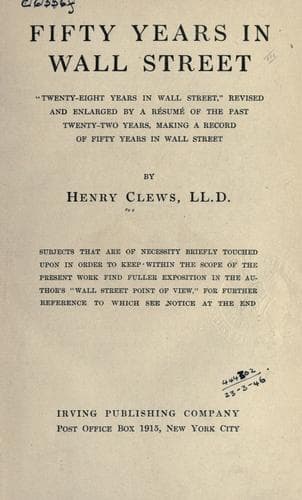
Business; Capitalists and financiers -- United States; Speculation; Wall Street (New York, N.Y.)
It is not, therefore, surprising, I think, that having placed my faith
in the integrity of that State and the promises of its officials and
governing power, and having been so basely deceived, that I should now
be aroused to act in self defence, fight for my rights and do all in my
power to cause the bonds or securities for which I paid good money to be
redeemed, and to have my just claims satisfied. It has therefore, been
incumbent upon me to leave no stone unturned in fighting this battle,
with the hope of recovering the money, or a part of it, that was filched
from me through the ostensible defalcations of these sovereign and
chivalrous States.
About thirteen years ago the repudiation which has reflected such
disgrace upon the South became prevalent in that section, and took the
character, for a time, of a severe financial epidemic.
It was for this reason that the Legislature of the State of New York, as
well as the legislatures of several other States, considered it
necessary for the protection of the savings banks, which are the
custodians of many hundreds of millions, chiefly of the hard earnings of
the working people, to prohibit these institutions from investing in, or
loaning upon, the securities of any State in the Union that had within
ten years previously repudiated any of its lawful obligations.
The laws of the State of New York, in chapter 409, section 260, of the
laws of 1882, provides that savings banks shall be prohibited from
investing money in stocks or bonds of any State which, in the language
of the statute, “has within ten years previous to making such investment
by such corporation defaulted in the payment of any part of either
principal or interest of any debt authorized by any legislature of such
State to be contracted.”
It was for this reason that the newly issued securities of some of the
Southern States have been unable to find a resting place in the monied
institutions of the North.
The State of Georgia, recently finding that she had some obligations
becoming due, and seeing that money was cheap in the North, and that
more than ten years had expired since she repudiated her former
obligations, thought there was a good opportunity of issuing a fresh
batch of these so-called securities, similar to those that had been
dishonored in 1873.
The politicians of Georgia thought there was a good opening in the State
of New York to remove the restriction placed upon the savings banks in
1882. They saw that the Governor and the Legislature were both
Democratic, with a Democratic Attorney-General also, and therefore
determined to take advantage of this political condition, which they
supposed was highly favorable to their scheme of stealing a march upon
the holders of the old repudiated bonds of Georgia, who had been chiefly
instrumental in getting the act passed for the safety of savings banks’
depositors in the State of New York.
Public-domain text, read in full here on John Shaqi.
Reviews
Reviews
No reviews yet
Be the first to share your thoughts on this work.
Elsewhere in the archive
Join the Discussion
Join the discussion
Sign in to leave a comment or review.
Sign InorCreate an account