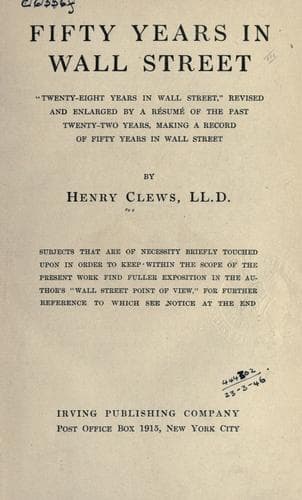
Business; Capitalists and financiers -- United States; Speculation; Wall Street (New York, N.Y.)
In December of last year the Atlanta _Constitution_, discussing
this subject, used the following language: “The burden of his
complaint is, that the bonds have never had a hearing in court.
This comes with poor grace from the ex-Governor, who, when the
validity of the bonds issued under his administration was being
discussed by the legislative committee, was absent from this
country, his whereabouts unknown, and his testimony not
procurable. The bonds were ‘in court’ then, and as Governor
Bullock was not present with his evidence when it was needed, he
should not complain that a new hearing is not had for his
benefit.” To this I made reply, which the _Constitution_ kindly
published, and I will thank you to copy as follows: “I desire to
say that I was not absent from the country. My whereabouts were
known, and my testimony was before the committee in the full and
complete report of the financial condition of the State which I
made to my successor, sustained by the official records of the
Executive and State Departments. I never received a request from
that committee to come before them in person, and my presence
would not have added to the information in their possession.
Every request received by me from my successors, to aid in their
investigations, has been promptly complied with. In accordance
with such request I met Dr. Bozeman, financial agent,
Attorney-General Hammond and Governor Smith, in New York, and
also subsequently, Colonel Snead, Attorney for the State, and
Colonel Kibbe, chairman of committee. No fact within my
knowledge has ever been withheld, nor have I ever neglected any
proper opportunity to contradict the statement that any of the
bonds issued during my administration and reported to my
successor were ‘bogus.’ But, Mr. Editor, the question is, shall
a debtor pass on the validity and enforce judgment against his
own indebtedness? I submit that a legislative investigating
committee is not ‘a court’ in the sense that its findings are
conclusive on questions of law. To hold a question so decided to
be _res adjudicata_, is to sustain a legislative usurpation of
the judicial functions of the government. If your position be
well taken, that because the Legislature has decided against the
bonds, the case is _res adjudicata_, and the judiciary is
precluded—of what avail is our constitutional guarantee that the
executive, legislative, and judicial branches of the government
shall be separate and distinct, and that neither shall encroach
upon the functions of the other? What protection has a citizen
for his property if a legislative decision upon a legal question
must be regarded as final _res adjudicata_?
Public-domain text, read in full here on John Shaqi.
Reviews
Reviews
No reviews yet
Be the first to share your thoughts on this work.
Elsewhere in the archive
Join the Discussion
Join the discussion
Sign in to leave a comment or review.
Sign InorCreate an account