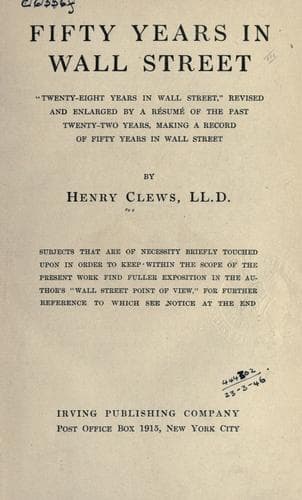
Business; Capitalists and financiers -- United States; Speculation; Wall Street (New York, N.Y.)
Had I not sprung General Dix on that Convention at the peculiar moment,
as described in the last chapter, Judge Robertson would have carried the
day with flying colors. It was a sudden and crushing blow to the
prospects of himself and his political friends, and it dissipated some
of the brightest hopes and brilliant schemes that had ever originated in
the fertile brain of Senator Conkling. As a consequence of the unique
turn that affairs took on that day, the Senator was placed in a false
position in relation to some of his best friends. Several of the latter
were put in an attitude whereby they misinterpreted the actions of
Senator Conkling at that Convention, and unjustly accused him of
betraying friends that he had promised to support. This was the result
of a misconception on their part, that the Senator was the prime mover
of the _coup d’etat_ that surprised the Convention in the nomination of
General Dix.
The credit was awarded to Conkling, without any hesitation or inquiry,
and he was either too proud, or too indifferent to public opinion to
explain. If he had explained his position candidly the chances are that
his explanation would have been taken in a Pickwickian or political
sense. In fact, he was in a position where he could hardly escape the
responsibility of Dix’s nomination, and everybody was ready to believe
that the movement in favor of Dix was too good a thing to be engineered
by a man of less calibre.
It would have been useless, therefore, for anybody else to explain, as
the person attempting to do so would only have been laughed to scorn.
Judge Robertson, himself the greatest sufferer by the curious turn
affairs had taken, was the first to believe that the nomination of Dix
was one of Conkling’s masterstrokes of political policy. He never
thought of looking to any other source for its emanation. He believed in
his soul it was the work of Conkling, and he thinks so to this day.
I happened to have been better informed, however; but my explanation
would have hardly passed muster at that time, and I would have been
charged with egotism if I had attempted to explain. I think an
explanation is now in order, however, and may point a moral as well as
help to adorn a tale.
History is said to be philosophy teaching by example, and one great
historian has said that no one event in itself is any more important
than another, except from what it teaches posterity by its example. So,
for the benefit of posterity, I now state the facts on this historical
principle.
I am willing to make affidavit on the revised edition of the good book
that prior to the Utica Convention the name of General Dix was not even
lisped by Senator Conkling within my hearing, nor was Dix ever thought
of even remotely by the Senator as a possible candidate.
Public-domain text, read in full here on John Shaqi.
Reviews
Reviews
No reviews yet
Be the first to share your thoughts on this work.
Elsewhere in the archive
Join the Discussion
Join the discussion
Sign in to leave a comment or review.
Sign InorCreate an account