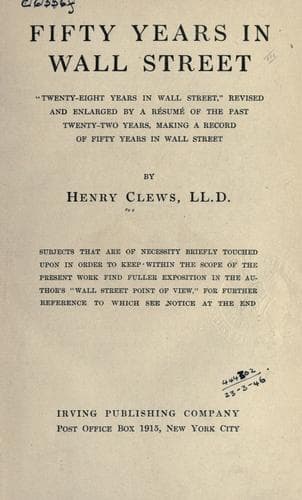
Business; Capitalists and financiers -- United States; Speculation; Wall Street (New York, N.Y.)
As day after day passed without any change, it seemed as if the Conkling
forces had adopted the motto of Napoleon’s old guard, “The Guard dies,
but does not surrender.”
At length Robertson and his lieutenants collected the shattered ranks of
Blaine and Sherman, and with Garfield at their head, like Ney attacking
the English centre at Waterloo, hurled them with desperation on the
solid square of Conkling, which still remained unbroken.
The united forces, however, with the war cry, “Anything to beat Grant!”
carried the day, Garfield was nominated and Conkling retired in good
order, but greatly discomfited.
Robertson had taken up this cry at the Convention in the same spirit
that was displayed by another man about whom a good story was told
during that campaign. He had got that shibboleth on the brain, “Anything
to beat Grant!” As the story goes, a prediction had been made by some
religious enthusiast that the world was coming to an end early in
November of that year. A preacher was reminding his congregation, one
Sunday, of the prediction, and the possibility of its fulfilment—at
least that it was well to be prepared for such an event. At the
conclusion of his exhortation, a man in the congregation arose to his
feet, and in a solemnly pathetic voice said, “Thank God.” At the end of
the service the minister’s curiosity was excited to converse with the
man who had so fervently thanked heaven for what most people regarded as
a universal calamity. He saw the man, and asked why he had made such a
remarkable ejaculation at the prospect of such a terrible consummation.
“Anything to beat Grant,” was the reckless and self-sacrificing
response.
It was in this spirit that the Robertson party made the fight at
Chicago, and in this spirit that they triumphed. It was anything to beat
Senator Conkling, however, so far as Judge Robertson was concerned, who
on other grounds would probably have preferred Grant. Thus he avenged
upon the wrong man his defeat at the Utica Convention, and I was
permitted to escape scathless, though innocently responsible for
blasting his Gubernatorial aspirations.
This was not the end of Judge Robertson’s enmity to Senator Conkling,
however. When the new Government came into power, Garfield, in making up
his cabinet, selected Blaine as a member of that special body. This
created a bad feeling between Blaine and Conkling, as it seemed to the
latter like a continuation of the conspiracy between Robertson and
Blaine, hatched at the Chicago Convention. Thus the seeds of a strong
and bitter antagonism were sown between these two leading spirits in the
Republican party, each aspiring to be at least the power behind the
throne.
Public-domain text, read in full here on John Shaqi.
Reviews
Reviews
No reviews yet
Be the first to share your thoughts on this work.
Elsewhere in the archive
Join the Discussion
Join the discussion
Sign in to leave a comment or review.
Sign InorCreate an account