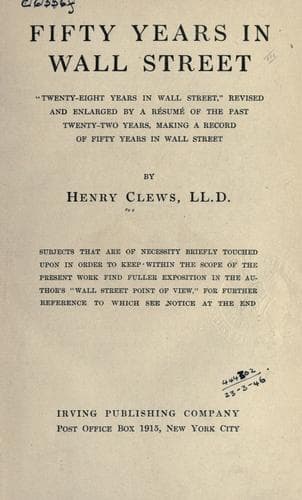
Business; Capitalists and financiers -- United States; Speculation; Wall Street (New York, N.Y.)
In seventy years the Commodore arose from nothing financially to be the
proud possessor of $90,000,000. Wm. H. obtained $75,000,000 of that and
nearly trebled it in a tenth part of the time. He made three times as
much in seven years as his father made in seventy, or he made as much on
an average every two and one-half years as his father had done during
the three score and ten of his active business and speculative career.
If any person having the necessary amount of temerity had ever ventured
to make such a prediction as this in the presence of the old Commodore,
what a natural burn idiot he would have been regarded by that grand old
man. If the spirits of the departed ever visited the glimpses of the
moon in these days, what a profound sense of humiliation that of old
Vanderbilt must feel, as it makes its nightly rounds through those
spacious marble corridors in Fifth avenue, or, perched on the dome of
the Grand Central Depot, it contemplates the mighty development and
expansion of its earthly designs, now extended far beyond the limits of
what its highest ambition had dared to foreshadow.
Some people may argue that it required greater ability to acquire these
first $90,000,000 than the present sum total of the wealth of the
Vanderbilts. Those who argue thus, however, have no precedent to suggest
their position. An instance of such prosperity on so large a scale in so
short a time has never occurred in the history of financiering. The
accumulations in all the wealthy families that I know of have been
comparatively slow, and the history of the family of European
millionaires shows a similar principle of gradation, except, indeed,
that the gradation in the majority of instances has gone backwards. Very
few wealthy men, with the exception of the Rothschilds, the Astors and a
few others, have had any children capable of increasing their wealth,
except where it was almost impossible to do otherwise under the law of
primogeniture. In this country, therefore, where the law of distribution
has full scope, Wm. H. Vanderbilt, who had to that time been regarded as
a man of very moderate capacity, proved himself to be the ablest
financier of which there is any record either in ancient or modern
history.
Public-domain text, read in full here on John Shaqi.
Reviews
Reviews
No reviews yet
Be the first to share your thoughts on this work.
Elsewhere in the archive
Join the Discussion
Join the discussion
Sign in to leave a comment or review.
Sign InorCreate an account