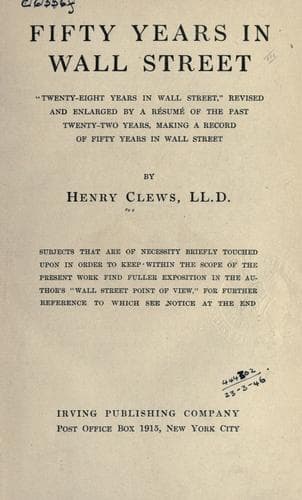
Business; Capitalists and financiers -- United States; Speculation; Wall Street (New York, N.Y.)
Mr. Gladstone said, “I suppose you mean the Duke of Westminster. The
Duke of Westminster’s property is not as large as that. I know all about
his property and have kept pace with it for many years past. The Duke’s
property is worth about £10,000,000 or $50,000,000, but it is not in
securities which can be turned into ready cash and thereby absorb the
current money of the country, so that he can make any dangerous use of
it, for it is merely an hereditary right, the enjoyment of it that he
possesses. It is inalienable, and it is so with all great fortunes in
this country, and thus, I think, we are better protected here in England
than you are in America.” “Ah, but like you in England, we in America do
not consider a fortune dangerous,” was the ready response.
The best proof of Wm. H. Vanderbilt’s great ability as a financier is
the marvellous increase in the value of the estate which he inherited
from his father during the seven years which he had the use and control
of it, and in which he did more than treble the value at which it was
estimated on the death of the Commodore.
The weakest financial operation on his part, known to the public, was
the purchase of the Nickel Plate Road, as regards the time of the
transaction, in which he was rather premature. It is now positively
known that if he had waited about a month longer the road would have
gone into bankruptcy and have fallen into his lap on his own terms. In
that case the West Shore would have followed suit.
In such an event I believe Mr. Vanderbilt would have been saved an
immense amount of money, remorse and mental strain, which, no doubt,
aggravated the malady which was the cause of his sudden death. He
realized his error when it was too late, and it was a source of great
mental anxiety to him in his latter days. He was very sensitive, and
nothing afforded him more gratification than a clean and successful
transaction, which drew forth public approval, and in the purchase of
Nickel Plate he was caught napping. It was a mistake for which the
Commodore, had he been alive, could never have forgiven him.
The syndicate that built the road had solely for their object to land it
upon either Gould or Vanderbilt, and it was upon its last legs at the
time it made the transfer to Mr. Vanderbilt. The syndicate laid a trap
for him. It had been coquetting with Mr. Gould in reference to the
purchase, and had made it to appear, through the press and other
channels of plausible rumors, that he had an eye upon the road. Mr.
Gould had occasion to go West about this time and the syndicate invited
him to make his homeward trip over the road, taking particular pains
that all these rumors and reports should reach the ears of Mr.
Vanderbilt, who was impressed with the idea that Mr. Gould’s trip was
one of inspection, with the intention of buying the road if he did not
anticipate him. This was just what the syndicate desired, and the
successful consummation of their financial plot.
Public-domain text, read in full here on John Shaqi.
Reviews
Reviews
No reviews yet
Be the first to share your thoughts on this work.
Elsewhere in the archive
Join the Discussion
Join the discussion
Sign in to leave a comment or review.
Sign InorCreate an account