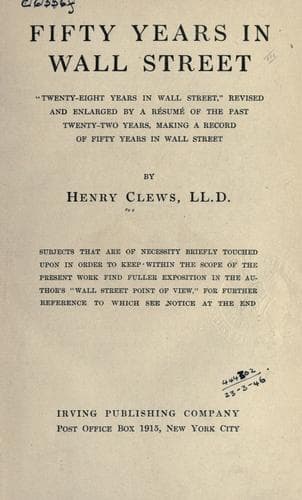
Business; Capitalists and financiers -- United States; Speculation; Wall Street (New York, N.Y.)
SECRETARY CHASE CONSIDERS THE PROBLEM OF PROVIDING A NATIONAL
CURRENCY.—HOW E. G. SPAULDING TAKES A PROMINENT PART IN THE
DISCUSSION ON THE BANK ACT.—THE ACT FOUNDED ON THE BANK ACT OF THE
STATE OF NEW YORK.—EFFECT OF THE ACT UPON THE CREDIT OF THE
COUNTRY.—A NEW SYSTEM OF BANKING REQUIRED.
The history of the Bank Act of 1863, improved by the Act of 1864, would
require much larger space than I can devote to it in this book. I can
only glance at its salient points, and show its great influence, not
only on the finances of the country, but upon the destiny of the nation
itself.
The Hon. E. G. Spaulding, who was one of the most prominent men in
dealing with the financial questions of that period, has written and
preserved a very full history of the legislation on the subject, and of
the interesting debates which preceded it.
After the temporary loans had been negotiated to release the pressure
upon the Government, Secretary Chase set his mind to consider the
problem of providing a currency without disturbing the business
organization of the country.
At this period he was met by a fresh difficulty, in the suspension of
specie payments, which had been hastened by the arrest of Mason and
Slidell, which, but for the wise policy of Mr. Seward, would have
precipitated a conflict with Great Britain.
Early in 1862 Congress authorized ten million more of demand notes. This
was followed by further issues, making in all 300 million United States
notes. Secretary Chase was at first opposed to making these notes a
legal tender for private debts, but in order to get the bill through, he
agreed to the legal tender clause, as the Government was greatly in need
of money.
The Secretary was also empowered by Congress to borrow 500 million
dollars on 5-20 year 6 per cent. bonds, and also to obtain a temporary
loan of 100 millions on condition that the interest on the bonds should
be paid in coin, and that the customs should be collected in coin for
that purpose.
The first bill to provide a national currency secured by a pledge of
United States bonds was introduced by Mr. Hooper, in July, 1862, but it
was not reported from the Committee to which it had been sent. At the
meeting of Congress in December the same year the financial problem had
become still more complicated, and owing to the magnitude which the war
had then assumed, the expenses amounted to two millions a day.
The total receipts for the fiscal year ending June 30, 1863, were 511
millions, and the expenditures were 788 millions, thus leaving a deficit
of 277 millions.
All the financial wisdom of the Secretary was necessary in this dilemma.
The question was whether to provide for these 277 millions by a fresh
issue of United States notes, or by interest-bearing loans.
Public-domain text, read in full here on John Shaqi.
Reviews
Reviews
No reviews yet
Be the first to share your thoughts on this work.
Elsewhere in the archive
Join the Discussion
Join the discussion
Sign in to leave a comment or review.
Sign InorCreate an account