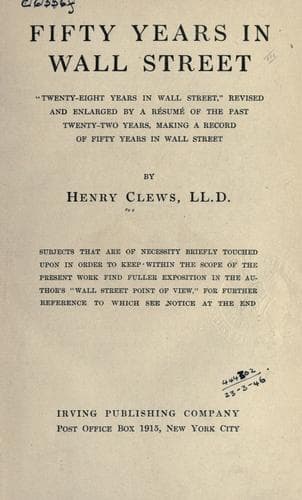
Business; Capitalists and financiers -- United States; Speculation; Wall Street (New York, N.Y.)
Mr. Spaulding, who advocated the bill, was followed by Mr. Fenton in an
able argument, showing the superiority of a currency secured by United
States bonds, and Senator Sherman explained the great evil occasioned by
the success attending the counterfeiting of the State bank notes.
These arguments seemed to be conclusive and overwhelming in the passage
of the bill.
It must not be forgotten, to the honor of the State of New York, that
the National Bank Act was founded on the Banking act of this State,
whose chief features were a currency secured on public funds, and that
directors and stockholders should be personally liable.
The authorship of this idea is attributed to Mr. Stillman, who is also
the well-known author of the “Stillman Act” to abolish imprisonment for
debt.
This bank act, which was especially engineered by the far-seeing
Secretary of the Treasury, Salmon P. Chase, had almost a miraculous
effect upon the credit of the country. It created a new and extensive
market for United States bonds, which immediately advanced from 93 to
par.
All the running expenses of the Government, accumulated with such
rapidity, were paid from the sale of the 5-20’s within the short period
of two months or thereabouts.
It was stated in the Treasury report at the end of the year that “The
Bank Act at once inspired faith in the securities of the Government,
and, more than any other cause, enabled the Secretary to provide for the
prompt payment of the soldiers and the public creditors.”
Mr. Hugh McCulloch, the Comptroller of the Currency, saw room for
certain changes in the law, some of which were effected by Congress in
the first session of 1864. These changes were embodied in the Act of
June, 1864.
There was a long debate and strenuous opposition, in which Secretary
Chase deeply sympathized, against State taxation of the national banks,
but despite the opposition the taxation clause was carried.
At length the modified act was passed, limiting the total amount of
United States notes to be issued to 400 millions, with such additional
amount, not exceeding 50 millions, as might be transiently required for
the redemption of the temporary loan, and thus the main features of the
Bank Act, which has served its purpose very well, became a law.
I hope, however, ere long, as I have more fully intimated in another
chapter, to see a superior system of banking, which I believe must
succeed the present system, which is now doomed to “innocuous desuetude”
through the imminent payment of the public debt.
[Illustration:
NEW YORK STOCK EXCHANGE.
]
------------------------------------------------------------------------
CHAPTER XI.
THE NEW YORK STOCK EXCHANGE.
Public-domain text, read in full here on John Shaqi.
Reviews
Reviews
No reviews yet
Be the first to share your thoughts on this work.
Elsewhere in the archive
Join the Discussion
Join the discussion
Sign in to leave a comment or review.
Sign InorCreate an account