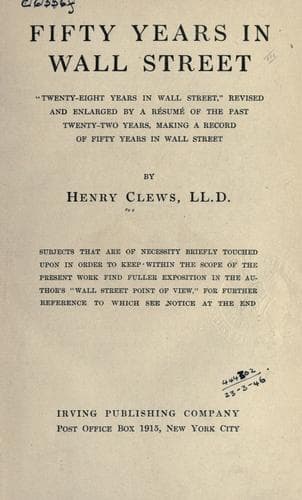
Business; Capitalists and financiers -- United States; Speculation; Wall Street (New York, N.Y.)
This arrangement existed, and was the only one by which the members were
bound, until 1820, when daily meetings and the regular call of stocks
began. The Board met in various places, including the old Merchants’
Exchange on the corner of Wall and William streets, but did not take
root in permanent shape until the year 1842, when it became established
in the new Merchants’ Exchange, now the Custom House. An illustration of
the old Merchants’ Exchange is given on another page. The sight of it
will doubtless awake a host of endearing reminiscences in the minds of
some of the oldest merchants and speculators. It will be remembered by
the few survivors of that period that about the year 1820 the meetings
of the Board were held in the office of Samuel J. Beebee, at 47 Wall
Street. The Board also met in a room in the rear of Leonard Bleecker’s;
also in the office of the old _Courier and Journal_. Subsequently the
meetings of the Board were held in an upper room of the old Merchants’
Exchange. This building was destroyed by the great fire of 1835, and
afterwards the new Merchants’ Exchange was built. The Board moved into
this building in 1842, and remained there until 1853. Up to this time
the Board was the very closest of corporations, its membership being
governed by the most iron-clad rules. There was no field for financial
news agencies in those days, for the Board kept its proceedings a
profound mystery, and its members were bound to the strictest secresy on
pain of expulsion. That wonderful development of our later civilization,
the ubiquitous interviewer, was then unknown. The business of the Board
excited the most intense curiosity, and so impatient did outsiders
become to learn the mysteries of the interior, that the members of an
open Board which was organized about the year 1837, after failing to
force themselves into the regular association, engaged a building next
to the Board-room, and dug the bricks out of the wall in order that they
might see and hear what was going on.
The Board removed from the Merchants’ Exchange building in 1863 to a
room in the Commercial Exchange Bank building, at the corner of Beaver
and William. About the year 1857, memorable as the period of the great
panic, and my advent in Wall Street, the Board removed to “Dan Lord’s
building,” which had entrances on William and Beaver streets. It was
here, about the time of my advent, in Wall street, more fully described
in another chapter, that some of the great speculators of that era
figured. Among these were Daniel Drew, Jacob Little, and the lightning
calculator, Morse, who made and lost a fortune of millions in little
more than a year. In this building the rule of secresy was not relaxed,
and the fact is on record that a hundred dollars a day were freely
offered for the privilege of listening at the key-hole during the time
of the calls. The Board continued to hold its meetings in this building
during the war, and up to 1865, when it removed to the present edifice.
Public-domain text, read in full here on John Shaqi.
Reviews
Reviews
No reviews yet
Be the first to share your thoughts on this work.
Elsewhere in the archive
Join the Discussion
Join the discussion
Sign in to leave a comment or review.
Sign InorCreate an account