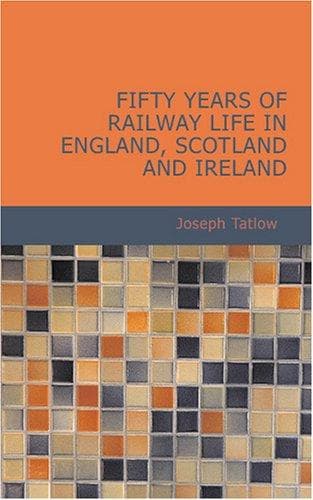
Fifty Years of Railway Life in England, Scotland and IrelandTatlow, Joseph
History
Fifty Years of Railway Life in England, Scotland and Ireland
Tatlow, Joseph
Railroads -- Great Britain -- History
Littler loved Pope, and so did all the Parliamentary Bar, of
which he was the acknowledged leader and the respected father. Littler
said to me, "He is a wonderfully and variously gifted man, and had he
chosen the stage as a profession would have been a David Garrick." I
said, "What about his very substantial person?" for he was colossal in
figure. "I had forgotten that," said Littler. Littler told me a good
story of him which Pope, he said, was also fond of telling himself.
It was in the great man's biggest and busiest days. Influenza was rife.
Mr. Pope was a bachelor, and his valet inconsiderately took the "flu."
Mr. Pope's nephew said the valet must go away till he fully recovered, or
Mr. Pope would be sure to take it. "What shall I do?" said Mr. Pope, in
dismay. "Oh, I'll get you a good man for the time," said the nephew; and
so he did; a skilful, quiet, efficient, attentive man, whose usual duty
it was to attend on a rich old gentleman, who resided, on account of a
little mental derangement, in a certain pleasant private establishment.
Mr. Pope had not been told, nor had he inquired, where the excellent
valet, with whom he was well pleased, hailed from, nor had the valet
asked any questions concerning Mr. Pope. Both seemed to have jumped to
certain conclusions. After the valet had been there a week or more, one
day, when _downstairs_, he said to the servants: "Tell me, what is it
that is wrong with the master? He seems to me to be as sane as any of
us!"
Balfour Browne, in his book _Forty Years at the Bar_, says, "He" (Mr.
Pope) "had a broad equitable common sense, and never did anything mean or
little." He was certainly an orator, and displayed in his speeches much
dramatic power. His voice was fine, flexible and sonorous. In his later
years he must often have wished his "too too solid flesh would melt," for
it had become a heavy burden. He had to be wheeled from Committee Room
to Committee Room in a perambulating chair, and was allowed to remain
seated when addressing Committees. On the 12th of July Lord Spencer
announced that "the Great Southern Amalgamation Bill may proceed subject
to clauses as to running powers, etc." This meant that _our_ Bill was
gone, and that the Great Southern had gained possession of the Waterford
and Limerick, Ennis, the line to Collooney and running powers to Sligo.
Thus they had secured a monopoly in Munster and an effective competition
with us in poor Connaught. It was hard lines for the Midland, but all
was not yet lost. If only we could obtain running powers to Limerick and
carry them back to Ireland, we should have secured some of the spoil.
Another week was spent fighting over running powers, facilities, etc.,
and I was in the witness box again. Balfour Browne and Littler now
conducted the warfare on either side, and keenly they fought. The
Committee at one time seemed disposed to put us off with little or
nothing. In the box I know I waxed warm--"the Great Southern to get all
Public-domain text, read in full here on John Shaqi.
Reviews
Reviews
No reviews yet
Be the first to share your thoughts on this work.
Elsewhere in the archive
Join the Discussion
Join the discussion
Sign in to leave a comment or review.
Sign InorCreate an account