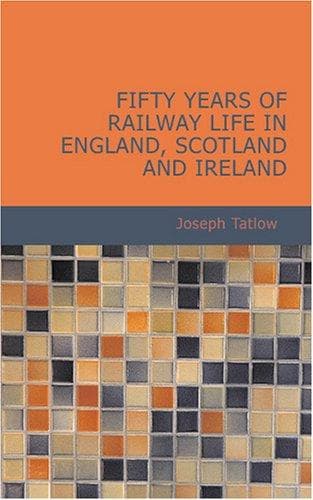
Fifty Years of Railway Life in England, Scotland and IrelandTatlow, Joseph
History
Fifty Years of Railway Life in England, Scotland and Ireland
Tatlow, Joseph
Railroads -- Great Britain -- History
The streets and bazaars of Constantinople were absorbingly interesting.
The various nationalities that everywhere met the eye; the flowing
eastern costumes, the picturesque water carriers, the public letter
writers patiently seated at street corners and occupied with their
clients, the babel of voices, and yet an Oriental indolence pervading
all, crowds but no hurry; the sonorous and musical sound of the Muezzin
call to prayers from the minarets--all was new and strange; delightful
too, if you except the dogs that beset the streets and over which, as
they lay about, we stumbled at every step. They are now a thing of the
past. Poor brutes, they deserved a better fate than the cruel method of
extinction which Turkish rule administered.
Of course we visited Stamboul's greatest Mosque, S. Sophia. Many other
Mosques we saw, but none that approached the majesty of this. One, the
Church of the Monastery of the Chora, famous for its beautiful mosaics,
we did not see, although the German Emperor had driven specially to it on
his visit in 1898 to the Sultan. The only good road Constantinople
seemed to possess was this road to the church, which lies outside the
city, and this road, we were told, was constructed for the convenience of
His Imperial Majesty.
One day, on the bridge that spans the Golden Horn, we passed the Grand
Vizier in his carriage. It was the day on which we crossed the Bosphorus
by steamer to visit Scutari on the Asiatic shore. Scutari commands a
splendid view of the city, the Golden Horn, and the Bosphorus in its
winding beauty, right away to the Black Sea. What a city some day will
Constantinople be! The grandest perhaps on earth. In Scutari we heard
the Howling Dervishes at their devotions, and the following day, in
Constantinople, witnessed a _performance_ shall I call it? of the Dancing
Dervishes in their whirling, circling, toe-revolving exercise. The
object of both is said to be to produce the ecstatic state in which the
soul enters the world of dreams and becomes one with God. There is no
question as to the ecstatic, nay frenzied state many of them attained.
Our last day was the eve of the Ramadan Fast. At eight o'clock that
night we left by train to journey homeward overland, for time demanded
that we should go back much quicker than we came.
We broke our journey for two days at Buda-Pesth, and looked on the
Danube; at Vienna we stayed a little longer, and found that gay city hard
to leave. We drove and rode in the Prater, and horseback exercise in
such a place was, I need not say, delightful. We stopped at Frankfort,
enjoyed its opera and other things, then, _via_ Ostend, wended our way to
London.
CHAPTER XXVI.
A CONGRESS AT PARIS, THE PROGRESS OF IRISH LINES, EGYPT AND THE NILE
Public-domain text, read in full here on John Shaqi.
Reviews
Reviews
No reviews yet
Be the first to share your thoughts on this work.
Elsewhere in the archive
Join the Discussion
Join the discussion
Sign in to leave a comment or review.
Sign InorCreate an account