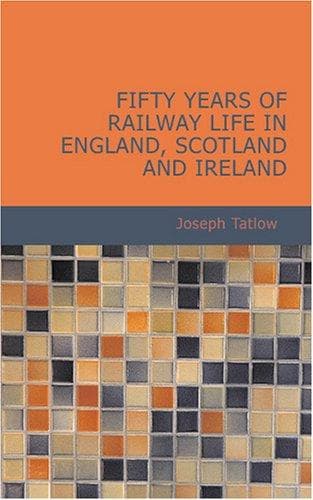
Fifty Years of Railway Life in England, Scotland and IrelandTatlow, Joseph
History
Fifty Years of Railway Life in England, Scotland and Ireland
Tatlow, Joseph
Railroads -- Great Britain -- History
Our almost daily intercourse was intimate and frank. Sometimes we
wandered into the pleasant fields of poetry and literature, but never to
the neglect of business. He had an advantage that I greatly envied; a
splendid memory; could repeat verse after verse, stanza upon stanza,
whole cantos almost, from his favourite poet, Byron. It was at the half-
yearly meetings of shareholders (they were held half-yearly in his day)
that he specially shone, not in his address to them (for that he _would_
persist in reading) but in the after proceedings when the heckling began.
This, during his chairmanship, was often severe enough, for owing to
unavoidably increased expenditure, dividends were diminishing and
shareholders, in consequence, were in anything but complacent mood.
Question time always put him on his mettle. Then his mother-wit came
out, his lively humour and practical common sense--all unstudied and
natural. The effect was striking. Rarely did he fail in disarming
criticism, producing harmony, and sending away dissentients in good
temper, though some of them, I know, sometimes afterwards wondered how it
came about that they had been so easily placated.
From 1903 to 1906 several Acts of Parliament affecting railways generally
came into force, four of which were of sufficient importance to merit
attention. The first, the _Railways (Electric Power) Act_, 1903, was a
measure to facilitate the introduction and use of electrical power on
railways, and invested the Board of Trade with authority to make Orders
for that purpose, which were to have the same effect as if enacted by
Parliament.
The second, the _Railway Fires Act_, 1905, was an Act to give
compensation for damage by fires caused by sparks or cinders from railway
engines, and increased the liability of railway companies. It _inter
alia_, enacted that the fact that the offending engine was used under
statutory powers should not affect liability in any action for damage.
Next came the _Trades Disputes Act_, 1906, a short measure of five
clauses, but none the less of great importance; a democratic law with a
vengeance! It is one of the four Acts which A. A. Baumann, in his recent
book, describes as being "in themselves a revolution," and of this
particular Act he says it "placed the Trade Unions beyond the reach of
the laws of contract and of tort." It also legalised peaceful picketing,
that particular form of persuasion with which a democratic age has become
only too familiar.
Lastly, the _Workmen's Compensation Act_, of 1906, an Act to consolidate
and amend the law with respect to compensation to workmen for injuries
suffered in the course of their employment, is on the whole a beneficial
and useful measure, to which we have grown accustomed.
Public-domain text, read in full here on John Shaqi.
Reviews
Reviews
No reviews yet
Be the first to share your thoughts on this work.
Elsewhere in the archive
Join the Discussion
Join the discussion
Sign in to leave a comment or review.
Sign InorCreate an account