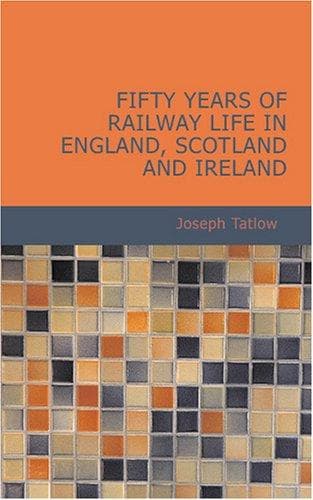
Fifty Years of Railway Life in England, Scotland and IrelandTatlow, Joseph
History
Fifty Years of Railway Life in England, Scotland and Ireland
Tatlow, Joseph
Railroads -- Great Britain -- History
On the question of reductions in rates (reductions which the Majority
Report strongly urged as necessary), they did not think that reductions
were more likely to occur under public than under private ownership. They
suggested, further, that the official statistics of various countries
showed that the fall in the average rate had been much greater on the
privately owned railways of France and the United States than on the
State-owned railways of Prussia, which were universally accepted as the
most favourable example of State managed railways in the world. They
came to the conclusion, after hearing all the evidence, that the
management of the principal Irish Companies was not inferior to that of
similar companies in England and Scotland. They narrated the many
improvements (with which they seemed much impressed) that Irish Companies
had in recent years effected for the benefit of the public and the good
of the country, and said "they had spent money, and not always
profitably, in endeavouring to promote the development of new
industries." They considered the principle of private ownership should
be maintained, believing that railways are better and more economically
managed by directors responsible to their own shareholders than they
would be under any form of State or popular control, and that
administration on commercial principles was the best in the public
interest.
In their opinion, however, the Irish railway system was faulty by reason
of its sub-division into so many independent companies, and they
recommended a policy of amalgamation, with the ultimate object of
including the principal railways in one single system, and also, that
certain lines classed as railways, but which were really tramways serving
purely local interests, need not be incorporated with the general railway
system. Such amalgamation, they considered, need not be effected at one
time, but should be accomplished gradually. Failing amalgamation by
voluntary effort within three years, compulsion should be resorted to.
On the whole the Reports were highly satisfactory to the Irish railways.
They showed that the Companies had done their duty to the country
honestly and well, and that they had been unjustifiably attacked. The
good character of the Irish railways was thus re-established, and they
again held their rightful place in public esteem.
Public-domain text, read in full here on John Shaqi.
Reviews
Reviews
No reviews yet
Be the first to share your thoughts on this work.
Elsewhere in the archive
Join the Discussion
Join the discussion
Sign in to leave a comment or review.
Sign InorCreate an account