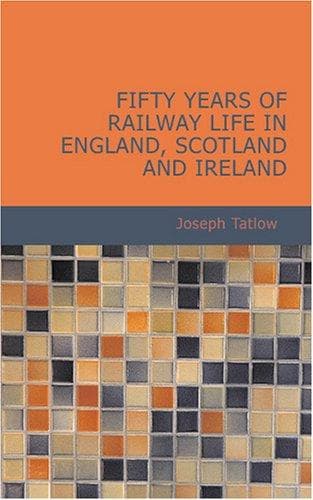
Fifty Years of Railway Life in England, Scotland and IrelandTatlow, Joseph
History
Fifty Years of Railway Life in England, Scotland and Ireland
Tatlow, Joseph
Railroads -- Great Britain -- History
I may, I am sure, be pardoned if I quote here some words from the report
of Sir James Allport's Commission on Irish Public Works. It is dated 4th
January, 1888. I had then been less than three years with the County
Down, and so could claim but a modicum of the praise it contains, and my
modesty, therefore, need not be alarmed. The words are: "_The history of
the Belfast and County Down Company is sufficient to show how greatly
both shareholders and the public may benefit from the infusion into the
management of business qualities. In that case a board of business men
have in ten years raised the dividend on the ordinary stock from nil to
5.5 per cent., while giving the public an improved service and reduced
rates_." My satisfaction was the greater as I had given evidence before
the Commission, and helped to tell them the cheerful story of the
progress and development of the County Down Company. It was my first
appearance as a railway witness and before Sir James Allport, who had
commanded my unbounded admiration from my first entrance at Derby into
railway life. Need I say that to me it was an event of importance.
In the year 1875 the Board of the County Down, after an investigation of
its affairs by a Committee of Shareholders, was reorganised, and it was
then that Mr. Richard Woods Kelly became Chairman, and Lord (then Mr.)
Pirrie a Director. The latter has more than once since told me that the
County Down shares were one of his best investments.
Mr. Kelly merits more than a passing word. Before I joined the County
Down I was told he was a "terror," and that I ran foolish risk in leaving
a service like the Glasgow and South-Western for a position in which I
might find it impossible to please. But fears like that never disturbed
me. To wrongdoers Mr. Kelly could certainly be "a terror," and
wrongdoers there were, I believe, in the service in the early days of his
chairmanship. He was a mild-mannered man, tall, rather pale, with
refined features and a low-toned pleasant voice. But beneath this smooth
and gentle exterior resided great firmness. He would smile and smile
with wonderful imperturbability and, in the quietest tones and the
blandest way, say severe and cutting things. Economy was his strong
point and he observed it in his public and private life with meritorious
consistency. Impervious to cold, as to most other human weaknesses, in
winter or summer he never wore an overcoat. His smooth face and tall
slight figure seemed as indifferent to the angry elements as bronze or
stone. By man or Nature I never saw him ruffled or in the least degree
disturbed. But he had his human side, as all men have, and in time I
discovered it and grew to like him. He was not at heart so cold as he
seemed. Though he could not write a page without mis-spelling some of
the words, his letters were always concise and very much to the point.
But it was only in spelling he was deficient. He spoke well, was a
Public-domain text, read in full here on John Shaqi.
Reviews
Reviews
No reviews yet
Be the first to share your thoughts on this work.
Elsewhere in the archive
Join the Discussion
Join the discussion
Sign in to leave a comment or review.
Sign InorCreate an account