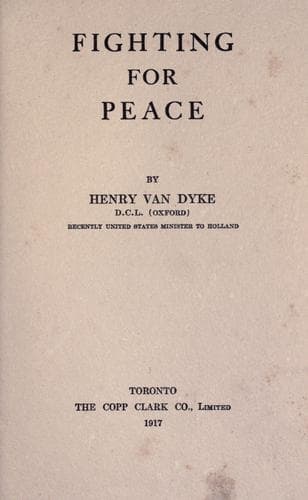
World War, 1914-1918 -- Germany; World War, 1914-1918 -- Personal narratives
"If a belligerent cannot retaliate against an enemy without injuring the
lives of neutrals as well as their property, humanity, as well as
justice and a due regard for the dignity of neutral powers, should
dictate that the practice be discontinued. If persisted in it would in
such circumstances constitute an unpardonable offense against the
sovereignty of the neutral nation affected. . . . The rights of neutrals
in time of war are based upon principle, not upon expediency, and the
principles are immutable. It is the duty and obligation of belligerents
to find a way to adapt the new circumstances to them." (The Secretary of
State, Washington, D. C., to the German Minister for Foreign Affairs,
July 21, 1915.)
"The law of nations in these matters, upon which the Government of the
United States based that protest" (i.e., against the German declaration
of February, 1915, declaring the danger zone around Great Britain and
Ireland) "is not of recent origin or founded upon merely arbitrary
principles set up by convention. It is based, on the contrary, upon
manifest principles of humanity and has long been established with the
approval and by the express assent of all civilized nations. . . . It
has become painfully evident to it (the Government of the United States)
that the position which it took at the very outset is inevitable,
namely--the use of submarines for the destruction of an enemy's commerce
is, of necessity, because of the very character of the vessels employed
and the very methods of attack which their employment of course
involves, utterly incompatible with the principles of humanity, the
long-established and incontrovertible rights of neutrals, and the sacred
immunities of non-combatants." (The Secretary of State, Washington, D.
C., to the German Minister for Foreign Affairs, April 18, 1916.)
"But we cannot forget that we are in some sort and by the force of
circumstances the responsible spokesmen of the rights of humanity, and
that we cannot remain silent while those rights seem in process of being
swept away in the maelstrom of this terrible war. We owe it to a due
regard for our own rights as a nation, to our sense of duty as a
representative of the rights of neutrals the world over, and to a just
conception of the rights of mankind to take this stand now with the
utmost solemnity and firmness." (President Wilson's Address to Congress,
April 19, 1916.)
"The present German warfare against commerce is a warfare against
mankind. It is a war against all nations. American ships have been sunk,
American lives taken, in ways which it has stirred us very deeply to
learn of, but the ships and people of other neutral and friendly nations
have been sunk and overwhelmed in the waters in the same way. There has
been no discrimination. The challenge is to all mankind. Each nation
must decide for itself how it will meet it." (President Wilson's Message
to Congress, April 2, 1917.)
Public-domain text, read in full here on John Shaqi.
Reviews
Reviews
No reviews yet
Be the first to share your thoughts on this work.
Elsewhere in the archive
Join the Discussion
Join the discussion
Sign in to leave a comment or review.
Sign InorCreate an account