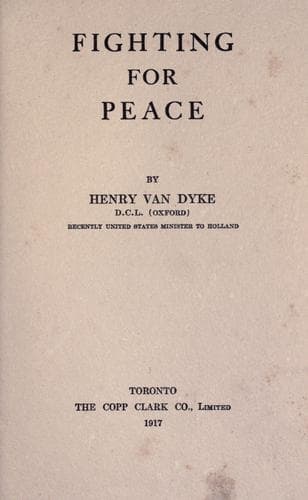
World War, 1914-1918 -- Germany; World War, 1914-1918 -- Personal narratives
In regard to the right of the peoples of the world, small or great, to
determine their own form of government and their own action, we are
fully committed. This principle is fundamental to our existence as a
nation. President Wilson has reaffirmed it again and again, never more
clearly or significantly than in his address to the Senate on January
22, 1917.
"And there is a deeper thing involved than even equality of rights among
organized nations. No peace can last which does not recognize and accept
the principle that governments derive all their just powers from the
consent of the governed, and that no right anywhere exists to hand
people about from sovereignty to sovereignty as if they were property.
"I take it for granted, for instance, if I may venture upon a single
example, that statesmen everywhere are agreed that there should be a
united, independent, and autonomous Poland, and that henceforth
inviolable security of life, of worship, and of industrial and social
development should be guaranteed to all peoples who have lived hitherto
under the power of governments devoted to a faith and purpose hostile to
their own."
This "example" must be interpreted in its full bearing upon all the
questions which are likely to come up in the conference in regard to the
terms of peace.
There is one more fixed point in the terms of a peace which the United
States and the Allies can accept with honor. That is the formation,
after this war is ended, of a compact, an alliance, a league, a
union--call it what you will--of free democratic nations, pledged to use
their combined forces, diplomatic, economic, and military, against the
beginning of war by any nation which has not previously submitted its
cause to international inquiry, conciliation, arbitration, or judicial
hearing.
Here, again, experience enables me to throw a little new light upon the
situation. In November, 1914, on my way home to America for surgical
treatment, I had the privilege of conveying a personal, unofficial
message to Washington from the British Minister of Foreign Affairs, Sir
Edward (now Viscount) Grey. Remember, at this time America was neutral,
and the "League to Enforce Peace" had not been formed.
This was the substance of the message: "The presence and influence of
America in the council of peace after the war will be most welcome to us
provided we can be assured of two things: First, that America stands for
the restoration of all that Germany has seized in Belgium and France.
Second, that America will enter and support, by force if necessary, a
league of nations pledged to resist and punish any war begun without
previous submission of the cause to international investigation and
judgment."
Public-domain text, read in full here on John Shaqi.
Reviews
Reviews
No reviews yet
Be the first to share your thoughts on this work.
Elsewhere in the archive
Join the Discussion
Join the discussion
Sign in to leave a comment or review.
Sign InorCreate an account