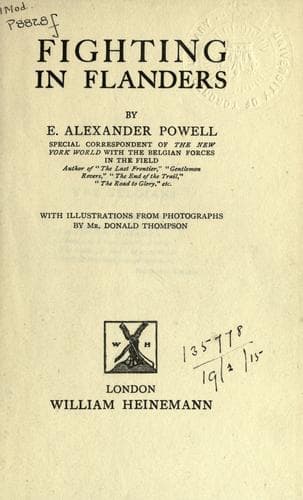
Fighting in FlandersPowell, E. Alexander (Edward Alexander)
History
Fighting in Flanders
Powell, E. Alexander (Edward Alexander)
World War, 1914-1918 -- Campaigns -- Belgium
By Tuesday night a boy scout could have seen that the position of
Antwerp was hopeless. The Austrian siege guns had smashed and
silenced the chain of supposedly impregnable forts to the south of
the city with the same businesslike dispatch with which the same
type of guns had smashed and silenced those other supposedly
impregnable forts at Liege and Namur. Through the opening thus
made a German army corps had poured to fling itself against the
second line of defence, formed by the Ruppel and the Nethe.
Across the Nethe, under cover of a terrific artillery fire, the Germans
threw their pontoon-bridges, and when the first bridges were
destroyed by the Belgian guns they built others, and when these
were destroyed in turn they tried again, and at the third attempt they
succeeded. With the helmeted legions once across the river, it was
all over but the shouting, and no one knew it better than the
Belgians, yet, heartened by the presence of the little handful of
English, they fought desperately, doggedly on. Their forts pounded
to pieces by guns which they could not answer, their ranks thinned
by a murderous rain of shot and shell, the men heavy-footed and
heavy-eyed from lack of sleep, the horses staggering from
exhaustion, the ambulance service broken down, the hospitals
helpless before the flood of wounded, the trenches littered with the
dead and dying, they still held back the German legions.
By this time the region to the south of Antwerp had been
transformed from a peaceful, smiling country-side into a land of
death and desolation. It looked as though it had been swept by a
great hurricane, filled with lightning which had missed nothing. The
blackened walls of what had once been prosperous farm-houses,
haystacks turned into heaps of smoking carbon, fields slashed
across with trenches, roads rutted and broken by the great wheels
of guns and transport wagons--these scenes were on every hand.
In the towns and villages along the Nethe, where the fighting was
heaviest, the walls of houses had fallen into the streets and piles of
furniture, mattresses, agricultural machinery, and farm carts showed
where the barricades and machine-guns had been. The windows of
many of the houses were stuffed with mattresses and pillows,
behind which the riflemen had made a stand. Lierre and Waelhem
and Duffel were like sieves dripping blood. Corpses were strewn
everywhere. Some of the dead were spread-eagled on their backs
as though exhausted after a long march, some were twisted and
crumpled in attitudes grotesque and horrible, some were propped
up against the walls of houses to which they had tried to crawl in
their agony.
All of them stared at nothing with awful, unseeing eyes. It was one
of the scenes that I should like to forget. But I never can.
Public-domain text, read in full here on John Shaqi.
Reviews
Reviews
No reviews yet
Be the first to share your thoughts on this work.
Elsewhere in the archive
Join the Discussion
Join the discussion
Sign in to leave a comment or review.
Sign InorCreate an account