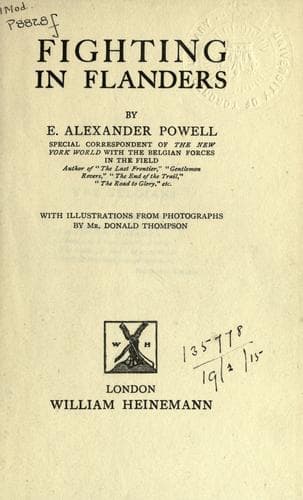
Fighting in FlandersPowell, E. Alexander (Edward Alexander)
History
Fighting in Flanders
Powell, E. Alexander (Edward Alexander)
World War, 1914-1918 -- Campaigns -- Belgium
The first troops to enter were a few score cyclists, who advanced
cautiously from street to street and from square to square until they
formed a network of scouts extending over the entire city. After
them, at the quick-step, came a brigade of infantry and hard on the
heels of the infantry clattered half a dozen batteries of horse artillery.
These passed through the city to the waterfront at a spanking trot,
unlimbered on the quays and opened fire with shrapnel on the
retreating Belgians, who had already reached the opposite side of
the river. Meanwhile a company of infantry started at the double
across the pontoon-bridge, evidently unaware that its middle spans
had been destroyed. Without an instant's hesitation two soldiers
threw off their knapsacks, plunged into the river, swam across the
gap, clambered up on to the other portion of the bridge and, in spite
of a heavy fire from the fort at the Tete de Flandre, dashed forward
to reconnoitre. That is the sort of deed that wins the Iron Cross.
Within little more than an hour after reaching the waterfront the
Germans had brought up their engineers, the bridge had been
repaired, the fire from Fort St. Anne had been silenced, and their
troops were pouring across the river in a steady stream in pursuit of
the Belgians. The grumble of field-guns, which continued throughout
the night, told us that they had overtaken the Belgian rearguard.
Though the bombardment ended early on Friday afternoon, Friday
night was by no means lacking in horrors, for early in the evening
fires, which owed their origin to shells, broke out in a dozen parts of
the city. The most serious one by far was in the narrow, winding
thoroughfare known as the Marche aux Souliers, which runs from
the Place Verte to the Place de Meir. By eight o'clock the entire
western side of this street was a sheet of flame. The only spectators
were groups of German soldiers, who watched the threatened
destruction of the city with complete indifference, and several
companies of firemen who had turned out, I suppose, from force of
training, but who stood helplessly beside their empty hose lines, for
there was no water. I firmly believe that the saving of a large part of
Antwerp, including the cathedral, was due to an American resident,
Mr. Charles Whithoff, who, recognizing the extreme peril in which
the city stood, hurried to the Hotel de Ville and suggested to the
German military authorities that they should prevent the spread of
flames by dynamiting the adjacent buildings. Acting promptly on this
suggestion, a telephone message was sent to Brussels, and four
hours later several automobiles loaded with hand grenades came
tearing into Antwerp. A squad of soldiers was placed under Mr.
Whithoff's orders and, following his directions, they blew up a
cordon of buildings and effectually isolated the flames. I shall not
soon forget the figure of this young American, in bedroom slippers
and smoking jacket, coolly instructing German soldiers in the most
Public-domain text, read in full here on John Shaqi.
Reviews
Reviews
No reviews yet
Be the first to share your thoughts on this work.
Elsewhere in the archive
Join the Discussion
Join the discussion
Sign in to leave a comment or review.
Sign InorCreate an account