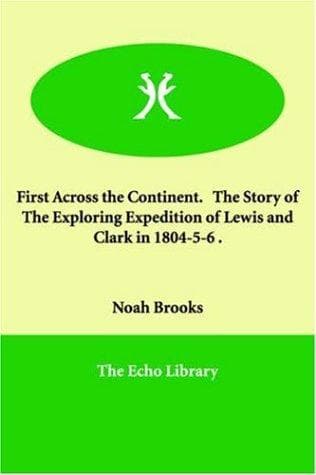
First Across the Continent: The Story of the Exploring Expedition of Lewis and Clark in 1804-5-6Brooks, Noah
History
First Across the Continent: The Story of the Exploring Expedition of Lewis and Clark in 1804-5-6
Brooks, Noah
Lewis and Clark Expedition (1804-1806); United States -- Discovery and exploration; West (U.S.) -- Description and travel
“The river was now about a mile wide, less rapid, and more divided by
islands, and bars of sand and mud, than heretofore; the low grounds,
too, were more extensive, and contained a greater quantity of
cottonwood, ash, and willows. On the northwest was a low, level plain,
and on the southeast some rugged hills, on which we saw, without being
able to approach them, some bighorns. Buffalo and elk, as well as their
pursuers, the wolves, were in great numbers. On each side of the
river there were several dry beds of streams, but the only one of any
considerable size was one to which they gave the name of Ibex River,
on the right, about thirty yards wide, and sixteen miles from their
encampment of the preceding night. The bear, which had given them so
much trouble at the head of the Missouri, they found equally fierce
here. One of these animals, which was on a sand-bar as the boat passed,
raised himself on his hind feet, and after looking at the party for a
moment, plunged in and swam towards them; but, after receiving three
balls in the body, he turned and made for the shore. Towards evening
they saw another enter the water to swim across; when Captain Clark
directed the boat towards the shore, and just as the animal landed shot
it in the head. It proved to be the largest female they had ever seen,
and was so old that its tusks were worn quite smooth. The boats escaped
with difficulty between two herds of buffalo that were crossing the
river, and came near being again detained by them. Among the elk of this
neighborhood they saw an unusual number of males, while higher up the
herds consisted chiefly of females.”
It is almost incredible that these wild animals should have been so
nearly exterminated by hunters and other rovers of the plains, very soon
after travel set in across the continent. The writer of these lines, who
crossed the plains to California so lately as 1856, saw buffalo
killed for the sake of their tongues, or to give rifle practice to
the wayfarers. After the overland railroad was opened, passengers shot
buffalo from the car-windows, well knowing that they could not get their
game, even if they should kill as they flew by a herd. There are no
buffalo nor elk where millions once roamed almost unmolested.
Early in the afternoon of August 3, the party reached the junction of
the Yellowstone and the Missouri, and camped on the same spot where they
had pitched their tents on the 26th of April, 1805. They were nearing
the end of their long journey.
But their troubles thickened as they drew near the close of their many
miles of travel. The journal for August 4 has this record:--
Public-domain text, read in full here on John Shaqi.
Reviews
Reviews
No reviews yet
Be the first to share your thoughts on this work.
Elsewhere in the archive
Join the Discussion
Join the discussion
Sign in to leave a comment or review.
Sign InorCreate an account