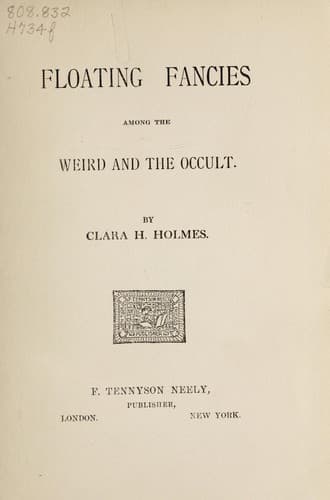
Floating Fancies among the Weird and the OccultHolmes, Clara H.
Science
Floating Fancies among the Weird and the Occult
Holmes, Clara H.
American fiction -- 19th century; Paranormal fiction; Short stories, American
From this time on how different the dull, prosaic work seemed; the
anticipation of the happy evening glorified each day, and he never
failed to come. He appeared to be perfectly content in her company; he
called her fond names, and usurped all the privileges of an accepted
lover. He occasionally alluded to business, sometimes ending with, “When
I get things into shape, I’ll pick you up and carry you off.”
Often Merna felt hurt, the allusions were so vague and really unmeaning,
and the talk of business so indefinite—the sentences never quite
complete—so that she had no certain knowledge as to what was his
business. A half-confidence is much more vexatious than no confidence as
it puts one to thinking; this was really no trust at all in her; just an
aggravating shadow, like a cloud over the summer sun, which when you
look upward in expectation of its grateful shade has sailed away.
A whole year passed away, and living in the light of his presence, her
uneasy feeling had mostly worn away; if she gave it thought—that in
reality she knew no more of the future than when he first returned, she
consoled herself, and excused him, by saying, “Oh, he is so odd, but he
means all right.”
As upon previous occasions there came an evening when she waited for him
in vain; she could not settle herself to anything, even the chatter of
her customers annoyed her, and her ear persistently hearkened for a
well-known footstep; something must have detained him unavoidably; he
would surely come to-morrow evening, but all the while her heart was
sinking heavily. He did not come the next evening, nor the one
following, and her fear grew to a certainty. She mentioned his name to
no one, but watched the passers-by on the street, feverishly; she
eagerly looked over the newspapers, hoping for a chance mention of him.
The days seemed so long and wearisome; the corners of her mouth took a
sad droop; the work grew so irksome. Others sought her company, but she
turned from them with dislike, or made comparisons to their great
detriment.
Business had heretofore been very good, but hard times came on, and
little by little trade dropped off; it grew dull, then vexatious and
finally exasperating; complaints were heard on every side. The days grew
doubly sad when no customers came in to break the heavy monotony; the
very silence grew oppressive, and Merna could scarcely restrain her
tears. Her heart grew hard and bitter toward Ned, toward the world, and
fate.
The wind whistled shrilly around the loosely built building, rattling
the boards and battens, and swaying the canvas walls and ceiling
dizzily, making Merna feel more desolate and despondent than usual. She
stood behind the cigar case, looking gloomily out upon the wind-swept
street; as if conjured up by her thought, Martin Balfour—her chief
creditor—entered the store.
He came in with a great swagger, and called for a cigar: “Gi’mme a good
one—twenty-five cent-er; I reckon I can afford it!” with an insolent
leer.
Public-domain text, read in full here on John Shaqi.
Reviews
Reviews
No reviews yet
Be the first to share your thoughts on this work.
Elsewhere in the archive
Join the Discussion
Join the discussion
Sign in to leave a comment or review.
Sign InorCreate an account