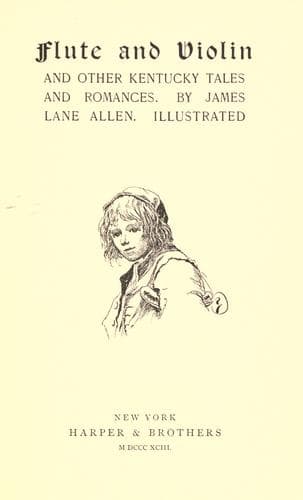
Flute and Violin, and Other Kentucky Tales and RomancesAllen, James Lane
General
Flute and Violin, and Other Kentucky Tales and Romances
Allen, James Lane
Kentucky -- Social life and customs -- Fiction; Short stories, American
To descend as a gay bird of passage, therefore, upon these secluded,
sombre fields, and find himself in the neighborhood of a powerful
Order--to learn that a girl, beautiful, accomplished, of wealth and
high social position, had of her own choice buried herself for life
within its bosom--gave him a startling insight into Kentucky history
as it was forming in his own time. Moreover--and this touched him
especially--it gave him a deeper insight into the possibilities of
woman's nature; for a certain narrowness of view regarding the true
mission of woman in the world belonged to him as a result of education.
In the conservative Kentucky society by which he had been largely
moulded the opinion prevailed that woman fulfilled her destiny when she
married well and adorned a home. All beauty, all accomplishments, all
virtues and graces, were but means for attaining this end.
As for himself he came of a stock which throughout the generations of
Kentucky life, and back of these along the English ancestry, had stood
for the home; a race of men with the fireside traits: sweet-tempered,
patient, and brave; well-formed and handsome; cherishing towards women
a sense of chivalry; protecting them fiercely and tenderly; loving them
romantically and quickly for the sake of beauty; marrying early, and
sometimes at least holding towards their wives such faith, that these
had no more to fear from all other women in the world than from all
other men.
Descended from such a stock and moulded by the social ideals of his
region, Helm naturally stood for the home himself. And yet there
was a difference. In a sense he was a product of the new Kentucky.
His infancy had been rocked on the chasm of the Civil War; his
childhood spent amid its ruins; his youth ruled by two contending
spirits--discord and peace: and earliest manhood had come to him only
in the morning of the new era. It was because the path of his life had
thus run between light and shade that his nature was joyous and grave;
only joy claimed him entirely as yet, while gravity asserted itself
merely in the form of sympathy with anything that suffered, and a
certain seriousness touching his own responsibility in life.
Public-domain text, read in full here on John Shaqi.
Reviews
Reviews
No reviews yet
Be the first to share your thoughts on this work.
Elsewhere in the archive
Join the Discussion
Join the discussion
Sign in to leave a comment or review.
Sign InorCreate an account